

A birth certificate requires paternity proof when a state's vital-records rules demand legal fatherhood before a father's name can be recorded, which applies to virtually all unmarried births and any disputed or corrected cases. Under federal paternity-establishment guidance, a signed Voluntary Acknowledgment of Paternity (VAP), a court-admissible DNA test, or a court order each satisfy that requirement. If you are unsure about biology, do not sign a hospital VAP until you have confirmed parentage through DNA testing or consulted an attorney.
Three legal routes satisfy the proof requirement:
- Voluntary Acknowledgment of Paternity (VAP): Both parents sign a witnessed or notarized form, typically at the hospital, which creates a legal finding of paternity.
- Legal DNA test (chain-of-custody): A witnessed, documented sample collection produces court-admissible results that vital-records offices and courts accept.
- Court order: A judge adjudicates paternity, then directs the vital-records office to amend the birth certificate.
Pro Tip: If either parent has any doubt about biology, pause before signing a hospital VAP. Undoing a signed acknowledgment is legally difficult and often requires proving fraud, duress, or material mistake of fact.
Table of Contents
- When does a state require paternity proof to add a father's name?
- How is paternity legally established in the U.S.?
- Why proving paternity matters beyond the birth certificate
- What evidence do states accept to add or change a father's name?
- How to get reliable DNA proof: a step-by-step checklist
- What US Diagnostics Center offers and where its limits are
- Your next steps if you need paternity proof now
- Key Takeaways
- A practitioner's perspective on paternity proof and timing
- Personal clarity starts here, legal proof when you need it
- Useful sources
- FAQ
When does a state require paternity proof to add a father's name?
Most states will not record a father's name on a birth certificate for an unmarried birth unless one of the three legal routes above has been completed. The trigger is straightforward: if the parents are not married at the time of conception or birth, no automatic legal presumption of fatherhood applies, and the state needs documented proof before it can enter a name.
Several specific situations routinely require formal proof:
- Unmarried parents at birth. Federal regulations require states to offer hospital-based voluntary paternity establishment services and to notify parents of the legal consequences before they sign any acknowledgment.
- Disputed paternity or corrections. If a different man is already listed, or if the original entry is challenged, a court order or formal genetic testing is generally required before the certificate can be amended.
- Married-at-conception scenarios. When the mother was married during the relevant period, a spousal presumption may attach automatically. Changing that presumption typically requires a court proceeding, not just a VAP.
- Age limits. North Carolina's vital-records guidance illustrates a common rule: if an Affidavit of Parentage was not filed before the child turned 18, a court order is generally required. Most states accept voluntary acknowledgments up to the child's 18th birthday, but acting earlier avoids complications.
Key fact: Under Social Security Administration policy, a father's name on a birth certificate for a child born outside of wedlock is treated as evidence of a written acknowledgment or court determination of paternity only when applicable state law required one of those instruments before the name could be entered.
How is paternity legally established in the U.S.?
Three distinct legal mechanisms exist, and each carries different procedural requirements and legal weight.

Voluntary Acknowledgment of Paternity (VAP)
A VAP is the fastest route at birth. Both parents sign a witnessed or notarized form, which is then filed with the state's vital-records registry. Once filed, it creates a legal finding of paternity and enables the father's name to be placed on the birth certificate. It also establishes the legal basis for child support, custody, and benefits claims. Critically, a VAP becomes binding unless the signing party challenges it within the state's rescission window, commonly 60 days in many states. After that window closes, a challenge requires proving fraud, duress, or material mistake of fact, a high legal bar.
Legal DNA testing (court-admissible)
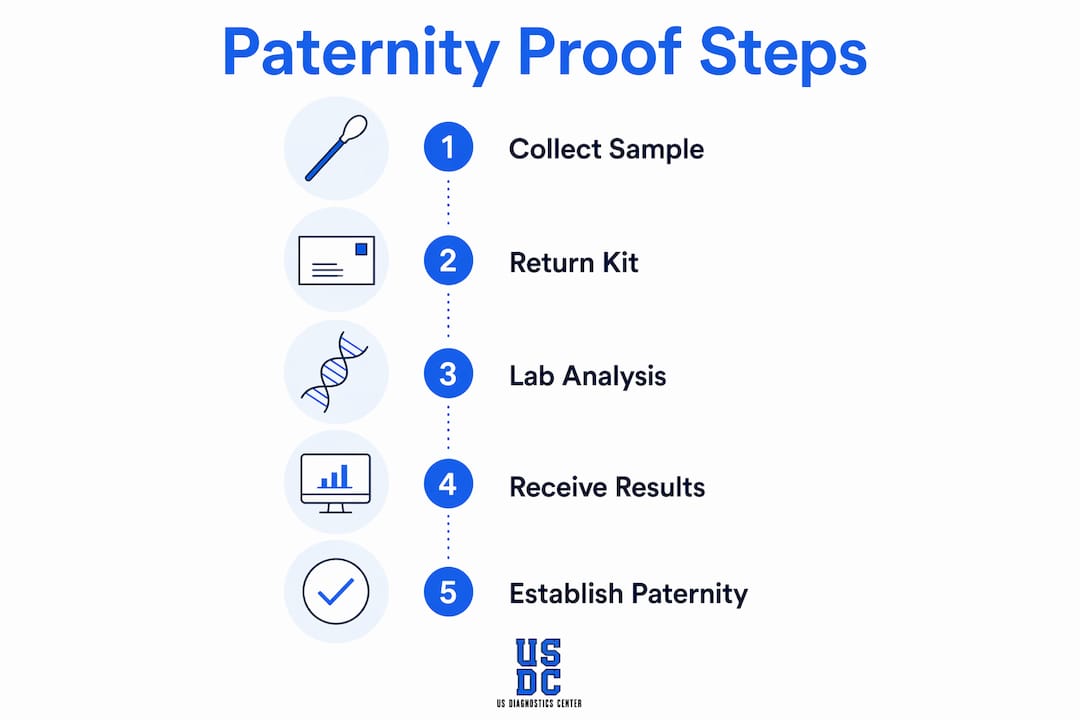
When consent is absent or biology is uncertain, a chain-of-custody DNA test provides objective proof. Sample collection must be witnessed and documented, with IDs verified at the time of sampling. Courts rely on properly conducted tests with probabilities of paternity considered strong evidence in contested cases. Some states accept certified genetic test results directly; others require a court order based on those results before amending the birth certificate.
Court-ordered paternity
When parties disagree, or when a legal presumption already attaches another man as father, a court can compel DNA testing and issue an order directing the vital-records office to amend the certificate. This route is slower and more costly but is often the only option in disputed or complex cases. For guidance on disputing paternity legally, including timelines and paperwork, the process is more involved than many families anticipate.
- VAP: fastest, requires mutual consent, binding after rescission window.
- Legal DNA test: objective, chain-of-custody required for court use, accepted by most vital-records offices.
- Court order: slowest, most formal, necessary when consent is absent or presumptions apply.
Pro Tip: Ohio's paternity guidance states plainly that parents who have doubts should not sign the affidavit without considering genetic testing first. That caution applies in every state.
Why proving paternity matters beyond the birth certificate
Legal fatherhood carries consequences that extend well past the certificate itself.
- Custody and child support. Established paternity is the legal prerequisite for a court to enter child support orders or allocate custody and visitation rights.
- Financial benefits. A child with established paternity may be entitled to Social Security survivors and retirement benefits, veterans' benefits, pension claims, and inheritance rights that would otherwise be unavailable.
- Health insurance and medical history. Legal fatherhood enables a child to be added to the father's health insurance plan and gives the child access to the paternal family's medical history, which can be significant for hereditary conditions.
- Emotional and social recognition. Legal recognition supports the father-child relationship and creates a clear, documented family record that the child can rely on throughout life.
What evidence do states accept to add or change a father's name?
The documents states commonly accept include a signed and notarized VAP, a court order adjudicating paternity, and in some jurisdictions, certified DNA test results submitted under required procedures. State rules vary meaningfully.
Louisiana's vital-records procedures illustrate one end of the spectrum: in certain situations, the state may require a court order or DNA-based proof before a birth certificate can be amended. Nevada's child support guidance confirms that a VAP must be notarized or witnessed and filed with the Office of Vital Records before the father's name is entered. Georgia's framework treats the appearance of the father's name on the birth certificate, entered with his written consent, as prima facie evidence of paternity establishment.
State variation matters. Some states accept administrative genetic test reports directly; others require a court order even when DNA results are conclusive. Always verify the exact document and filing requirements with your state's vital-records office before submitting anything.
For Florida families, a family law attorney familiar with birth-certificate paternity can clarify which documents the state requires and whether a court proceeding is necessary.
How to get reliable DNA proof: a step-by-step checklist
- Determine the intended use. Decide whether you need results for personal clarity only or for legal filing with a court or vital-records office. That distinction determines which test type you need.
- Choose the right test type. A home DNA kit provides personal clarity quickly and affordably. A legal, chain-of-custody test is required when results must be submitted to a court or vital-records office. For details on what courts require in a legal-grade test, chain-of-custody documentation is non-negotiable.
- Schedule collection. For legal tests, use a provider that documents chain-of-custody and verifies IDs at collection. For personal tests, follow the kit's collection instructions carefully.
- Submit samples and retain documentation. Keep copies of all forms, IDs, and shipping receipts. These records support later legal use if circumstances change.
- Understand cost and timeline. US Diagnostics Center's home paternity test is priced at $79; maternity testing is $129; sibling, grandparent, and avuncular tests are $139. Lab processing runs 2–3 business days, with a typical order-to-results timeline of 7–10 business days. Every kit includes a prepaid return shipping envelope, and testing covers up to 28 markers.
Cost and timeline snapshot: Home paternity $79 | Maternity $129 | Sibling/Grandparent/Avuncular $139 | Lab processing 2–3 business days | Order-to-results 7–10 business days | Up to 28 markers tested.
Pro Tip: If results will be used in court or to amend a birth certificate, choose the legal chain-of-custody option even if it costs more. Vital-records offices and courts often will not accept results collected without witnessed, documented chain-of-custody procedures.
What US Diagnostics Center offers and where its limits are
US Diagnostics Center provides at-home and legal DNA test kits for paternity, maternity, sibling, grandparent, and avuncular testing, along with a guided test-selection tool that helps families identify the right test for their specific situation.
Key service details:
- Marker coverage: Up to 28 markers per test.
- Processing time: 2–3 business days lab processing; 7–10 business days typical order-to-results.
- Pricing: Home paternity $79; maternity $129; sibling, grandparent, and avuncular $139.
- Shipping: A prepaid return shipping envelope is included with every kit.
- Accreditation status: For context on what AABB accreditation means for DNA testing quality, the standard covers laboratory procedures and chain-of-custody protocols.
- Service exclusions: US Diagnostics Center does not offer prenatal non-invasive paternity testing, immigration-specific testing, or ancestry and ethnicity testing.
When results must be court-admissible, the legal chain-of-custody test option is the appropriate choice. For complex kinship scenarios where the alleged father is unavailable, kinship DNA testing through grandparent or sibling tests can provide supporting biological evidence.
Pro Tip: Keep all test paperwork, chain-of-custody forms, and certified lab reports together in one file. Vital-records offices and courts typically require the complete documentation package, not just the results summary.
Your next steps if you need paternity proof now
- Do not sign a hospital VAP if you have doubts. Pause and arrange DNA testing first. Rescinding a signed acknowledgment is legally complex and requires clearing a high evidentiary bar.
- Contact your state vital-records office or local child support agency. Ask specifically which documents they require to add a father's name and whether a court order is necessary in your situation.
- Choose the right test for your purpose. For court-admissible proof, schedule a legal chain-of-custody test. For personal clarity before making any legal decisions, a standard at-home kit may be sufficient.
- Assemble your documentation. Gather all IDs, shipping receipts, chain-of-custody forms, and certified lab reports before submitting anything to a court or vital-records office.
Additional contacts to confirm your state's exact filing requirements:
- Your state's vital-records office (search "[state name] vital records paternity").
- Your local child support enforcement agency, which can often arrange or facilitate genetic testing.
- A family law attorney if the case is contested or involves an existing legal presumption of paternity.
Key Takeaways
A birth certificate requires legal proof of paternity for unmarried births because no automatic fatherhood presumption exists, and a VAP, legal DNA test, or court order each satisfy that requirement depending on the circumstances.
| Point | Details |
|---|---|
| Three legal routes | A VAP, a chain-of-custody DNA test, or a court order each satisfy state proof requirements for adding a father's name. |
| VAP rescission window | Challenging a signed VAP after the rescission window typically requires proving fraud, duress, or material mistake of fact. |
| State rules vary | Some states accept certified DNA results directly; others require a court order before amending a birth certificate. |
| Legal vs. personal tests | Only a chain-of-custody legal test is admissible in court or accepted by vital-records offices; home kits serve personal clarity. |
| US Diagnostics Center | Offers home paternity tests from $79 and legal DNA test kits with up to 28 markers and 7–10 business day turnaround. |
A practitioner's perspective on paternity proof and timing
The families who face the most difficulty are rarely those who tested too early. They are the ones who signed a VAP at the hospital under pressure, or who waited years before seeking legal clarity, and then discovered that undoing a legal finding of paternity requires a formal court proceeding with a demanding burden of proof. Early, documented DNA testing reduces that risk substantially. If there is any uncertainty about biology, the cost of a DNA test before signing is far lower than the legal cost of challenging an acknowledgment afterward.
For contested cases, or any situation where a legal presumption already attaches another man as father, consulting a family law attorney alongside DNA testing is the most practical path. State vital-records offices can confirm which documents they require, but they cannot give legal advice about how to navigate a dispute. Both resources serve different purposes, and families benefit from using both.
Personal clarity starts here, legal proof when you need it
When you need a fast answer about biological parentage before making any legal decisions, US Diagnostics Center's home DNA test kits start at $79, include a prepaid return shipping envelope, and deliver results within 7–10 business days. Testing covers up to 28 markers, and expedited processing is available for urgent situations.
For situations where results must be submitted to a court or vital-records office, the legal DNA test option uses chain-of-custody collection procedures that courts and state agencies require. Home kits are not a substitute for legal chain-of-custody testing when court-admissible proof is required. To find the right test for your situation, visit US Diagnostics Center's paternity testing guide and use the guided selection tool.
Useful sources
- OCSE/ACF Child Support Handbook, Chapter 3: Establishing Fatherhood — federal guidance on VAP procedures, genetic testing, and the legal consequences of paternity establishment.
- Federal Register: Paternity Establishment Regulations (1999) — the regulatory basis for hospital-based voluntary paternity establishment services and required parental notice.
- North Carolina Vital Records: Paternity Establishment — state-level filing procedures, affidavit requirements, and the age-18 court-order rule.
- Louisiana Department of Health: Paternity Information — example of a state that may require a court order or high-probability DNA proof before amending a birth certificate.
- Ohio Department of Job and Family Services: Paternity Information — state guidance warning parents not to sign a VAP when uncertain about biology.
- FindLaw: Legal Significance of Paternity — overview of how courts treat chain-of-custody DNA results and the legal weight of paternity findings.
- US Diagnostics Center: Paternity Testing Guide — explains home vs. legal test differences, marker counts, and how to choose the right test.
- US Diagnostics Center: Legal DNA Tests — court-admissible chain-of-custody test kits with documented collection procedures.
This article provides general information about U.S. paternity law and birth-certificate procedures. It is not legal advice. Confirm current requirements with your state's vital-records office, child support agency, or a qualified family law attorney for your specific situation.
FAQ
Why does a birth certificate need paternity proof for unmarried parents?
When parents are not married, no automatic legal presumption of fatherhood applies, so states require a VAP, legal DNA test, or court order before a father's name can be recorded on the birth certificate.
What is the difference between a home DNA test and a legal paternity test?
A home DNA test provides personal clarity through self-collected cheek swabs but is not court-admissible. A legal paternity test uses witnessed, chain-of-custody sample collection and documented IDs, producing results that courts and vital-records offices accept.
Can you add a father's name to a birth certificate after the child is born?
Yes. A VAP can be signed after birth, and a court order can direct an amendment at any point, though some states require a court order rather than a VAP once the child reaches age 18.
How accurate are paternity DNA tests?
Courts typically accept properly collected and documented genetic tests with probabilities of paternity near 99% as strong evidence. US Diagnostics Center tests up to 28 markers per sample.
What happens if you sign a VAP and later discover you are not the biological father?
Challenging a signed VAP after the rescission window requires proving fraud, duress, or material mistake of fact in a formal court proceeding, a high legal bar that makes early DNA testing the more practical approach.
Recommended
- How to Establish Paternity: Every Option Explained (2026) | USDC
- Paternity Test for Child Support: What Courts Require (2026) | USDC
- Legal Paternity Test: What Courts Require in 2026 | USDC
- Paternity Test When Possible Fathers Are Related (2026) | USDC
This article is part of our Paternity Testing: The Complete Guide guide.


0 comments