

The right choice depends on two questions: which relationship you need to confirm, and what the result needs to accomplish. For personal clarity between two living relatives, a home paternity, maternity, sibling, grandparent, or avuncular kit answers the question directly. If the result must hold up for a court filing, birth-certificate correction, or probate matter, you need a test performed under documented chain-of-custody with witnessed collection, not a mail-order kit. A guided test selector can help match your scenario to the correct kit.
TL;DR:
- Full sibling tests are more reliable than half sibling tests because they compare shared genetic markers, with full siblings sharing roughly twice the genetic overlap.
- Legal tests require documented chain-of-custody and are performed under strict protocols, whereas consumer kits lack this documentation and are not usually court admissible.
- Testing up to 28 markers increases accuracy in kinship reports, especially for sibling and grandparent tests where genetic distinctions are narrower.
- A typical home test costs between $79 and $139, with results available in 7 to 10 business days, and expedited options can deliver results the next day.
- Confirming relationships through testing involves careful preparation, informed consent, and sensitive communication, especially considering emotional and legal implications.
Table of Contents
- Which Kinship Test Fits Your Reunion Scenario?
- Legal Tests vs. Consumer Kits: What Chain-of-Custody Actually Means
- What Happens When You Collect a DNA Sample?
- How Do You Read a Kinship Test Result?
- What Do Reunion DNA Tests Cost, and How Long Do They Take?
- How Do You Prepare to Order the Right Test?
- The Emotional and Ethical Weight of Testing for Reunion
- How Do You Talk to Biological Relatives After Results Come In?
- What Legal and Privacy Issues Come With Reunion Testing?
- Where Can Adoptees and Birth Families Find Support?
- Expert Note From Dr. Todd Lewis
- Order the Right Kinship Test With Confidence
- Sources
- FAQ
Which Kinship Test Fits Your Reunion Scenario?
Adoption reunions rarely present a clean paternity question with both parties available. More often, one biological parent is unreachable, deceased, or simply not part of the conversation yet, which means the test has to work around the people who are actually available.
A paternity or maternity test is the simplest path when the child and the alleged parent can both provide a sample. It directly compares two people rather than inferring a relationship through a third party, which makes it the fastest route to a confident answer.
Full and half sibling tests come into play when two people believe they share one or both parents but neither parent is testable. These tests compare shared genetic markers between the siblings themselves. A full sibling test carries stronger statistical power than a half sibling test, because full siblings share roughly twice the expected genetic overlap, so results can read as more probable but rarely as absolute as a direct parent match.
Grandparent and avuncular (aunt/uncle) tests solve the problem when the parent in question has died or cannot be located. These tests analyze likelihood ratios across the tested relatives, and combining multiple relatives, such as both grandparents or an aunt plus a sibling, increases the confidence of the report.
- Paternity/maternity: fastest, most direct, requires both people
- Full sibling: strong statistical power when both parents are unavailable
- Half sibling: useful but generally less conclusive than full sibling testing
- Grandparent/avuncular: the practical option when a parent has passed away or is unreachable
Legal Tests vs. Consumer Kits: What Chain-of-Custody Actually Means
Chain-of-custody is the documented, unbroken record of who collected a DNA sample, how it was identified, and how it moved from collection to the lab without being altered or mixed up. Courts and government agencies rely on this paper trail, not just the lab’s science, to accept a result as evidence.
Consumer-style ancestry kits can reveal that two people are biologically connected, but they are not generally admissible in court because they lack that documented chain-of-custody. Legal relationship tests use STR markers analyzed under strict identification protocols instead of the SNP arrays consumer kits rely on for broad genealogical matching.
Situations that typically demand a legally defensible test include:
- Court-ordered paternity or custody proceedings
- Correcting or establishing a birth certificate
- Probate and inheritance disputes involving a biological relationship
- Any legal filing where an agency requires documented sample collection
AABB accreditation and chain-of-custody documentation are commonly required for tests used in court or immigration cases, and some state courts caution that at-home kits are unlikely to be accepted without witnessed collection through an approved facility. Some providers offer court-admissible or legal testing, so readers who need that documentation should work with a provider that specializes in it.
What Happens When You Collect a DNA Sample?
Most kinship tests start with a buccal swab, a soft brush rubbed against the inside of the cheek for about 30 seconds per side. Here’s the general sequence:
- Order the correct kit based on which relationship you’re confirming.
- Receive the kit containing swabs, collection tubes, instructions, and a prepaid return shipping envelope.
- Collect samples from each participant, following instructions on how long to avoid eating or drinking beforehand.
- Verify identity and consent for each adult participant, and obtain a parent or guardian’s consent for any minor.
- Mail the samples back using the prepaid envelope included in the kit.
- Lab receives and processes the samples, running them against the panel of genetic markers for the requested relationship.
Home collection works fine for personal answers. If the result needs to be defensible later, witnessed collection at an approved facility, where a neutral third party verifies identity and observes the swab, is the version courts expect.
How Do You Read a Kinship Test Result?
Reports use specific language, and knowing what it means before you open the envelope makes a real difference in how you process the news.
For paternity and maternity tests, results typically report either exclusion, meaning 0% probability, or a very high probability of inclusion, often 99.9% or above. There’s rarely a murky middle. Sibling, grandparent, and avuncular tests work differently: instead of a binary exclusion or inclusion, they present a likelihood ratio or probability percentage reflecting how much more likely the tested relationship is compared to two unrelated people sharing the same genetic overlap by chance.
- Exclusion (0%): the tested individuals are not biologically related as suspected.
- High probability (99%+): strong statistical support for the relationship, standard for direct parent/child tests.
- Moderate probability: more common in sibling and avuncular tests, especially with only one relative tested.
Thresholds and how labs phrase them can vary by jurisdiction and by test type, so read the report’s actual language rather than assuming every test uses the same scale.
Pro Tip: If a sibling or avuncular result comes back with a moderate rather than a high probability, testing an additional relative, such as a second sibling or the other grandparent, can raise the confidence of the report before you draw a firm conclusion.
Whatever the outcome, give yourself room before making decisions. A confirming result often triggers a rush of relief or grief that deserves space, and an excluding result can raise new questions worth discussing with a counselor before you decide what to do next.
What Do Reunion DNA Tests Cost, and How Long Do They Take?
Budget and timing questions come up early, and the answers vary less than people expect once you know which test you need.
Sample pricing at US Diagnostics Center runs $79 for a home paternity test, $129 for a home maternity test, and $139 for sibling, grandparent, or aunt/uncle testing. Turnaround follows a consistent pattern across kit types: lab processing takes 2 to 3 business days once samples arrive, with standard order-to-results typically running 7 to 10 business days; expedited processing is available for families who can’t wait.
- Home paternity: $79
- Home maternity: $129
- Sibling, grandparent, or aunt/uncle: $139
- Lab processing: 2–3 business days
- Standard order-to-results: 7–10 business days
Marker count matters more than most people realize. Testing up to 28 markers increases the discriminatory power of a kinship report, which becomes especially important for sibling and avuncular tests where the statistical distinction between “related” and “unrelated” is narrower than in a direct parent comparison.
How Do You Prepare to Order the Right Test?
A little preparation before you check out saves time and avoids ordering the wrong kit.
- Confirm the purpose first. Decide whether this result needs to satisfy your own curiosity or a legal/administrative requirement, since that determines whether you need a home kit or a witnessed legal test.
- Identify your participants. Figure out who is available to test. If a parent is unreachable, plan for a grandparent or avuncular test and ask relatives directly whether they’re willing to participate.
- Prepare documentation. Have government-issued ID ready for each adult, arrange consent for any minor participant, and confirm whether witnessed collection is required for your situation.
Before you order, ask the provider three questions: how many markers the test analyzes (look for up to 28), what the realistic turnaround is once samples reach the lab, and how sample identity and chain of custody are documented if you might ever need that record later.
Pro Tip: Reach out to potential participants before you buy the kit, not after. A test sitting unused because a relative changed their mind is a common, avoidable delay.
The Emotional and Ethical Weight of Testing for Reunion
A DNA test in an adoption reunion is never just a lab result. It’s often the moment years of speculation either resolve or multiply, and that weight deserves acknowledgment before the swab ever touches a cheek.
Consider timing carefully. Requesting a test the same week you’ve reconnected with a possible biological relative can feel rushed to the other person, even when your motives are entirely reasonable. Many adoptees and birth family members find it helps to build some rapport first, so the test reads as confirmation of a connection already forming rather than the sole basis for one.
Consent matters just as much as accuracy. Every adult participant should understand what the test measures, who will see the results, and what happens to their sample afterward. Nobody should feel pressured into swabbing their cheek because a family member is anxious for an answer.
There’s also the question of what you’ll do with an unexpected result. Reunion testing sometimes reveals a relationship that isn’t what anyone hoped for, or confirms one that upends a family narrative someone had believed for decades. Thinking through both outcomes ahead of time, ideally with a counselor or trusted friend, makes the actual moment of opening results easier to handle regardless of which way it goes.
Respect extends to the people not in the room too. A biological parent or sibling who declines to test has that right, and pushing past a clear “no” tends to damage the relationship you’re hoping to build far more than any DNA report could repair.
How Do You Talk to Biological Relatives After Results Come In?
The words you choose in the first conversation after results arrive often matter more than the science behind them.
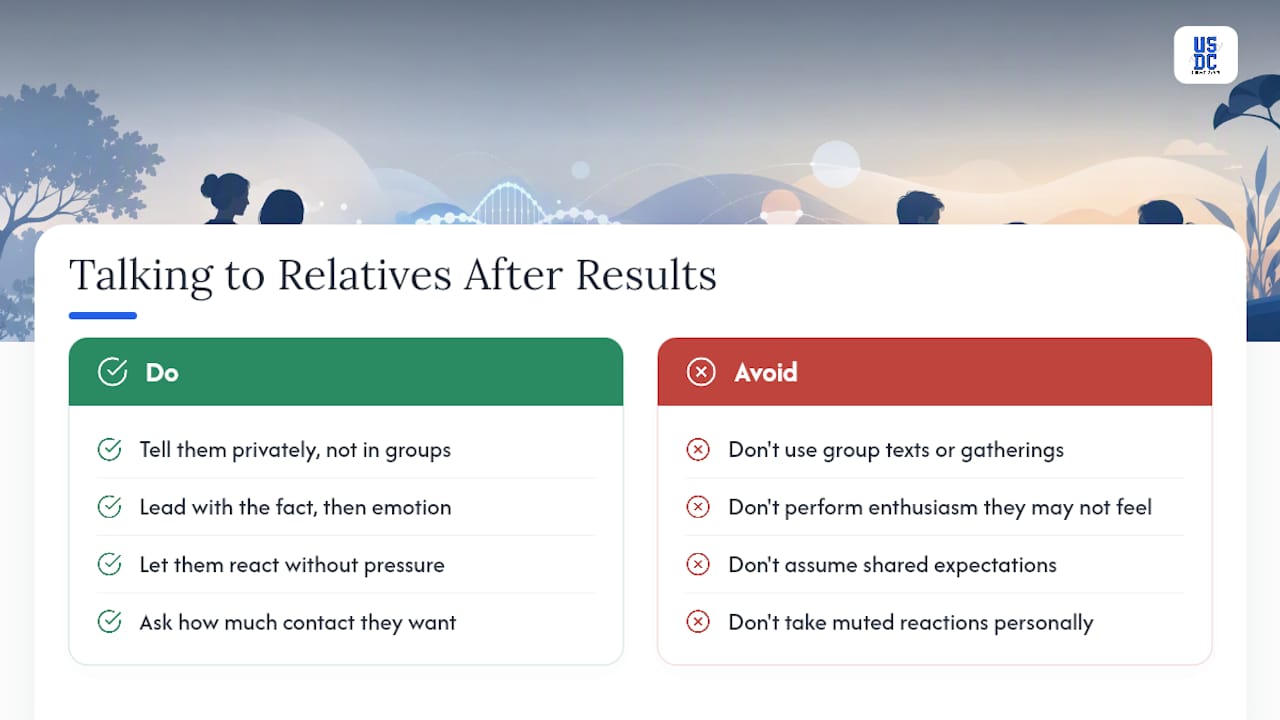
Start by sharing the news privately, not in a group text or a family gathering. Whether the result confirms a relationship or excludes one, the person on the other end deserves a direct, unhurried conversation where they can react without an audience.
Lead with the fact, then let emotion follow naturally rather than performing enthusiasm you’re not sure the other person shares. Something as plain as “the test confirmed we’re siblings, and I wanted you to hear that from me directly” gives the other person room to respond honestly instead of matching a tone you set for them.
Expect a range of reactions, and don’t take a muted one personally. Some biological relatives have spent years preparing for this exact possibility; others are caught completely off guard, even when they initiated the testing. A birth parent who agreed to test might still need weeks to process what a confirmed match means for a life they built around a different story.
Set expectations about pace early. Ask directly how much contact the other person wants, whether they’re comfortable being introduced to other family members yet, and what they’d prefer you not share publicly or on social media. Reunion relationships that survive long term tend to be the ones where both sides negotiated boundaries early instead of assuming shared expectations.
If the result excludes a suspected relationship, extend the same care. Confirming that someone isn’t a biological match can close one door while reopening painful questions about the search itself, and that person may need as much support processing a “no” as another might need processing a “yes.”
What Legal and Privacy Issues Come With Reunion Testing?
Genetic results carry legal weight in some contexts and none in others, and knowing which situation you’re in prevents costly surprises.
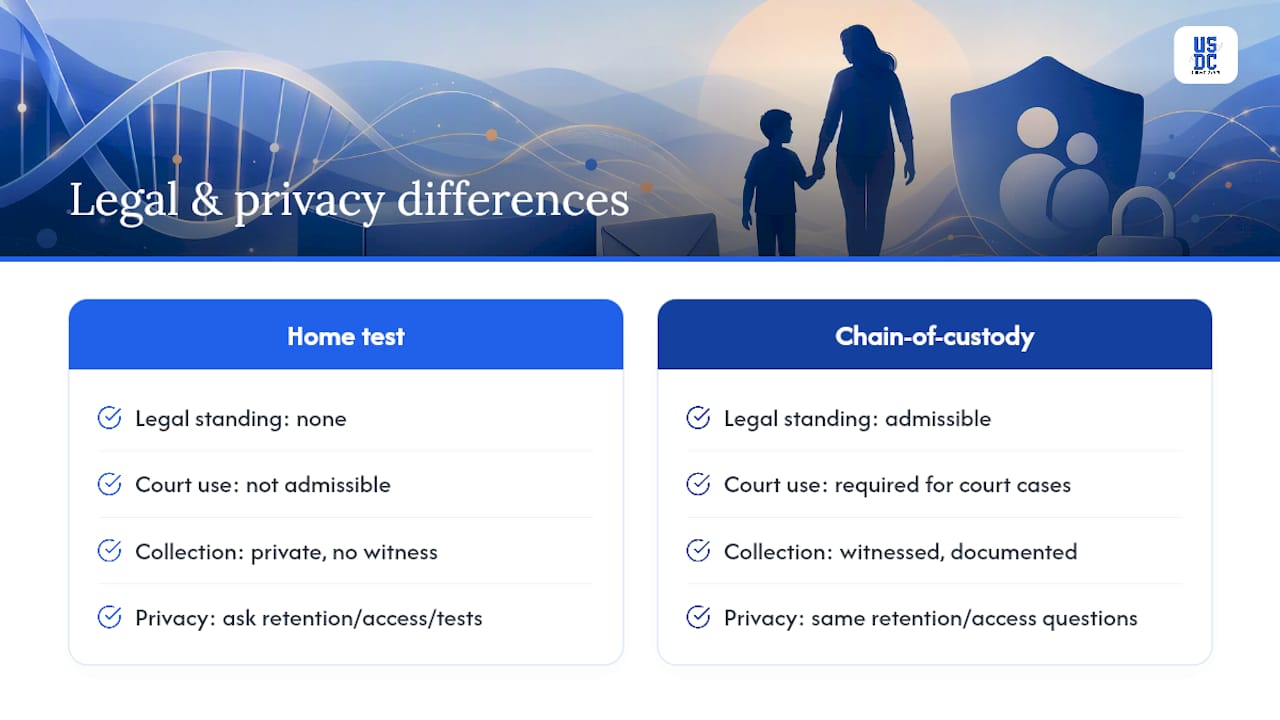
A home kinship test purchased for personal clarity generally has no legal standing on its own. If a reunion eventually leads to a court matter, such as an inheritance dispute or a request to amend a birth certificate, the informal home result won’t carry weight; that process requires the documented chain-of-custody testing discussed earlier, with witnessed collection through an approved facility.
Privacy deserves equal attention. Before you test, ask any provider how long they retain samples, whether the sample can be tested for anything beyond the relationship question you asked about, and who has access to the raw results. A reunion built on trust shouldn’t be undermined by unclear data practices on the testing side.
There’s also a quieter legal consideration: testing a relative without their knowledge, even out of good intentions, can create real friction if it surfaces later. Most states don’t have a blanket law against secretly testing a family member’s discarded sample, but the ethical and relational cost of doing so is almost always higher than the value of a faster answer. Getting consent, even when it’s an uncomfortable conversation to start, protects the relationship you’re trying to build.
If a reunion touches immigration paperwork or another government process, treat that as its own separate track requiring specialized legal guidance rather than assuming a home kinship test result will transfer over.
Where Can Adoptees and Birth Families Find Support?
Testing is only one piece of a reunion. The emotional infrastructure around it, counselors, peer groups, and search professionals who’ve guided others through the same territory, often matters just as much as the lab result itself.
Adoption-competent therapists, meaning counselors specifically trained in the psychology of adoption and reunion, can help both sides process a result before and after it arrives. This differs meaningfully from general family counseling, since adoption reunions carry a specific mix of grief, identity questions, and loyalty conflicts that a generalist may not be prepared to navigate.
Peer support groups, many organized locally or through national adoption organizations, connect adoptees and birth parents with others who have lived through a reunion. Hearing how someone else handled an awkward first phone call or managed a birth parent’s initial reluctance can be more useful than any article, because it comes from lived experience rather than theory.
Search and support organizations that specialize in adoption reunions can also help with the parts of the process that have nothing to do with genetics: locating current contact information, mediating a first introduction, or simply talking through whether now is the right time to reach out at all.
If your reunion involves questions about legal documentation, a family law attorney familiar with adoption and parentage issues in your state is worth consulting before, not after, a result changes anyone’s legal standing.
Expert Note From Dr. Todd Lewis
Sibling and grandparent tests get treated as a formality, but they carry real statistical limits when only one relative is available to test. Testing an additional relative when the first result is inconclusive can increase confidence, and it can be helpful to discuss results with family members to plan next steps.
— Dr. Todd Lewis
Order the Right Kinship Test With Confidence
You’ve seen how much the right test depends on who’s available and what the answer needs to accomplish. US Diagnostics Center built its guided test selector specifically for that decision, matching your reunion scenario to the correct kit instead of leaving you to guess between a sibling test and an avuncular one.
Home paternity testing starts at $79, maternity at $129, and sibling, grandparent, or aunt/uncle testing at $139, each processed with up to 28 markers and a prepaid return envelope included in the kit. Most results are ready in 7 to 10 business days from order to result, with expedited Next-Day Results available for $100 when you can’t wait the standard window. Families weighing a sibling test specifically can also read through common situations where sibling testing is the right call before deciding.
Start at the home DNA test collection to browse kits by relationship and place your order today.
Sources
FAQ
Can a home DNA test be used in court?
Generally no. Courts typically require witnessed collection through an approved facility with documented chain-of-custody, and at-home kits are often not accepted as valid evidence without that process.
What’s the difference between an ancestry kit and a relationship test?
Ancestry kits use SNP arrays for broad genealogical matching, while relationship tests use STR markers designed for definitive kinship conclusions. Ancestry results can suggest a connection but don’t carry legal weight on their own.
How much does a home kinship test cost through US Diagnostics Center?
Home paternity testing costs $79, maternity is $129, and sibling, grandparent, or aunt/uncle testing is $139. Expedited Next-Day Results are available for an additional $100.
How long does it take to get results?
Lab processing typically takes 2 to 3 business days once samples arrive, with standard order-to-results running 7 to 10 business days. Expedited processing shortens that window for urgent situations.
What if the closest available relative is a grandparent or aunt/uncle?
Grandparent and avuncular tests work well when a direct parent can’t be tested, and testing additional relatives can strengthen the statistical confidence of the result. US Diagnostics Center’s guided selector can point you to the right kit based on which relatives are available.
Recommended
- Paternity Testing Options After Birth (U.S.)
- Grandparent DNA Testing for Family Rights Cases (U.S.)
- Kinship DNA vs Ancestry Kits: Why the Difference Matters (U.S.)
- Documented DNA Testing: What Families Should Know (U.S.)
This article is part of our Kinship DNA Testing: Sibling, Grandparent, and Family Relationship Tests guide.


0 comments