

For this article, “dna test legal forms” refers to the enrollment and consent paperwork that accompanies personal-use at-home kinship DNA kits, not court forms. These documents record who is being tested, confirm consent, and set data-sharing preferences, but they are not court-admissible and do not substitute for a legal test. Filling them out correctly means completing every identity field, signing the consent section, and reviewing the privacy settings before you mail anything back.
TL;DR:
- Accurate completion of all identity and contact information, including full legal name and signed consent, is crucial to prevent delays or sample rejection.
- Understanding each consent option, such as data use, storage, research opt-in, and third-party sharing, helps you control your genetic information and privacy.
- Proper sample collection, labeling, and matching names on the form, label, and online account are vital for ensuring test accuracy and avoiding review issues.
- Court-admissible tests require verified identity, chain-of-custody documentation, and possibly notarization, unlike personal-use kits that involve only consent and simple collection.
Table of Contents
- What the enrollment and consent form includes
- How to collect, label, and return samples correctly
- Privacy, data retention, and what your consent choices mean
- Timeline, cost, and what marker count means for your results
- Consent for minors and testing another adult
- When you need a legal test instead of a home kit
- How legal DNA test forms differ by purpose
- Legal standards that govern DNA consent forms
- Verifying and notarizing consent forms for court use
- What happens when forms are incomplete or improperly signed
- Who signs or witnesses forms in legal testing
- Balancing curiosity, family impact, and privacy
- Ordering your kit and completing the forms with US Diagnostics Center
- Sources
- FAQ
What the enrollment and consent form includes
A personal-use kit form asks for several categories of information, and getting each one right the first time avoids delays. The identity and contact section requires the donor’s full legal name, date of birth, and a mailing or email address, along with a note on who is completing the form if it is not the donor.
The purpose section asks you to select the relationship being tested, such as paternity, sibling, grandparentage, or avuncular, since the lab uses this to determine which markers and comparisons to run. Consent checkboxes typically cover four separate permissions, and each one should be read on its own rather than accepted as a block.
- Data use consent confirms the lab may process your sample to generate results for the relationship you selected.
- Storage consent determines whether your genetic material or profile is kept after testing or destroyed.
- Research opt-in is a separate choice about whether your de-identified data can be used in outside studies.
- Third-party sharing covers whether results or data may be shared with partner labs or services.
Many kits also offer an online account in addition to the paper form, and the account may include optional fields such as a photo upload or an emergency contact that the paper form does not ask for.
How to collect, label, and return samples correctly
Getting the paperwork right matters just as much as the swab technique, since a mismatched name or a missing signature can delay results. Following a consistent order keeps the form, the label, and the sample aligned.
- Prepare: Read the entire form before opening the kit, gather any identification the instructions request, and create the online account first if the kit requires activation.
- Collect: Swab the inside of each cheek for the full time listed in the instructions, then write the donor’s name and the collection date directly on the form and on the sample tube label.
- Sign: The donor signs the consent line, and a separate collector signs if someone other than the donor performed the swabbing; a witness signature is only needed when the kit specifically requests one.
- Return: Seal the sample in the provided tube, place the signed form in the same package, and use the prepaid return envelope included with the kit.
Pro Tip: Write the donor’s name identically on the form, the label, and any online account profile. Even small spelling differences are a common reason samples get flagged for review.
Privacy, data retention, and what your consent choices mean
The checkboxes on a kit form are not boilerplate. Each one grants the company a specific permission, and understanding what it actually allows helps you decide what to leave checked. A research opt-in, for example, typically permits your de-identified genetic data to be used in studies beyond your own test, while a storage consent determines whether your sample or profile stays in a lab’s system after your results are delivered.
- Data use consent lets the company process your sample only for the test you ordered.
- Storage consent decides if your genetic material stays on file for future re-testing.
- Research opt-in is a separate permission you can decline without affecting your own results.
- Third-party sharing governs whether your data leaves the company that collected it.
The FTC advises consumers to review a company’s privacy promises and data-sharing policies before buying a DNA kit, not just its price or turnaround time. That guidance exists because privacy failures have real consequences: the FTC finalized an order with 1Health.io after finding the company failed to secure genetic data, failed to honor its own deletion promises, and did not notify consumers when it changed its privacy policy retroactively.
One documented enforcement action against a DNA testing company shows that deletion requests and privacy policies are not always honored as written, which is why reviewing account settings matters as much as filling out the form correctly. If you want to limit retention, look for a deletion request option in your account settings, but understand that deletion may not remove data already shared with a research partner before you revoked consent. After ordering, it is worth returning to your account to opt out of research sharing if you did not intend to opt in, and to enable multi-factor authentication if the platform offers it.

Timeline, cost, and what marker count means for your results
Lab processing for a personal-use kinship kit typically takes 2 to 3 business days once your sample arrives, while the full order-to-results window, including shipping both directions, usually runs 7 to 10 business days. Expedited processing is available on many kits for customers who need answers sooner, generally cutting the lab portion of that timeline down significantly.
Pricing varies by relationship type. Home paternity kits are available at a modest price point, maternity kits cost somewhat more, and sibling, grandparent, or aunt and uncle kits generally cost more due to additional genetic comparisons.
- Home paternity kits are generally the least expensive option, reflecting a simpler two-person comparison.
- Maternity and kinship kits cost more because they often require comparing additional genetic markers to confirm a less direct relationship.
- Marker count describes how many genetic locations the lab compares, and testing up to 28 markers generally increases statistical confidence in a kinship result compared to fewer markers.
- Expedited processing shortens the lab turnaround but does not change how the form itself is completed.
More markers do not change what you write on the form, but they do affect how confident you can be in the relationship the results describe.
Consent for minors and testing another adult
When a child is being tested, a parent or legal guardian signs the consent section on the child’s behalf and should note their relationship to the child directly on the form. Keeping a dated copy of that signed consent, along with any digital confirmation from the online account, protects everyone involved if a question comes up later.
Testing another adult without their knowledge carries real risk. Genetic testing affects biological relatives beyond the person swabbed, and ethical and policy reviews note that state rules on surreptitious testing vary, so the safer course is always to obtain that person’s informed, written consent before collecting a sample. Getting a clear yes, and documenting it, preserves trust within the family regardless of what the results eventually show.
Pro Tip: Keep a signed, dated note from every adult donor along with a saved copy of any digital consent confirmation. That paper trail matters if a relative later questions how or why a sample was collected.
When you need a legal test instead of a home kit
Some situations call for a court-admissible test rather than a personal-use kit, and it helps to recognize the difference before you order. A legal test is generally required when a court, a state child-support agency, or another government body needs documented proof of a biological relationship, such as in a custody dispute or a child-support determination.
- Child-support proceedings typically require chain-of-custody documentation that a home kit cannot provide.
- Court orders for paternity or kinship almost always specify a legal, supervised collection process.
- Personal-use kits answer a private question but were not built to meet a court’s evidentiary standards.
If your situation involves a court or a government agency, a court-admissible test follows a different collection and documentation process than the kit described in this guide, and it is worth confirming which one you actually need before you order anything.
How legal DNA test forms differ by purpose
Court-admissible DNA testing is not one uniform process. Paternity cases handled through family court typically require identity verification of every participant, a supervised collection at an approved facility, and a signed chain-of-custody form that travels with the sample from collection to the lab. Immigration-related DNA testing, when required by a government agency, generally follows strict protocols set by that agency, including specific collection locations and documentation requirements that differ from a family court case. Criminal cases involve their own chain-of-custody standards, often set by law enforcement or a forensic lab, with additional requirements for who may handle the sample and how it is logged at each step.

The common thread across all three is documentation and identity verification: a legal form exists to prove, beyond dispute, whose sample was collected, when, and by whom, in a way that a personal-use kit’s consent form was never designed to do. A personal-use kit form asks who the donor is and what they consent to; a legal form must additionally prove that the answer to that question cannot reasonably be challenged in a courtroom or by a government reviewer. Because the specific requirements depend on which agency or court is requesting the test, anyone facing one of these situations should confirm the exact documentation needed with the requesting court, agency, or a legal DNA testing provider before scheduling a collection.
Legal standards that govern DNA consent forms
Rules governing DNA test consent vary by the purpose of the test and the jurisdiction requesting it, so there is no single nationwide standard that applies to every situation. Family courts generally require that consent and collection follow state-specific procedural rules, which is why a legal paternity test ordered in one state may involve a different process than one requested in another. Federal agencies that request DNA evidence, such as in certain immigration matters, follow their own internal protocols rather than state family court rules.
What stays consistent across jurisdictions is the underlying principle behind informed consent: a genomic testing framework, as the NHGRI describes it, should clearly explain what the test involves, what the risks and benefits are, and what the implications are for family members who share DNA with the person being tested. That principle applies whether the form in front of you is a personal-use kit’s consent checklist or a legal document prepared for a court. Because legal standards differ by state and by the type of proceeding involved, anyone completing a legal DNA form should confirm the specific requirements with the requesting court or agency rather than assuming one state’s rule applies everywhere.
Verifying and notarizing consent forms for court use
Legal DNA test forms generally require a level of verification that a personal-use kit form does not. This typically starts with confirming the identity of each participant, often through a government-issued photo ID checked at the time of collection, along with a signature that ties that identity directly to the sample collected that day. Some legal proceedings additionally require notarization of the consent or collection form, which means a notary public witnesses the signature and confirms the signer’s identity before adding their own seal and signature to the document.
Notarization requirements are not universal. Whether a specific form needs a notary’s seal, and which fields the notary must witness, depends on the court or agency requesting the test, so it is worth confirming that detail before the collection appointment rather than after. A form that is signed but not notarized when notarization was required can create problems later, since the document may not meet the evidentiary standard the requesting party needed. Anyone unsure whether their situation calls for notarization should ask the court, agency, or testing provider handling the legal request directly, since the answer depends on the specific proceeding.
For families who need notarization but cannot easily reach an in-person notary, remote online notarization services such as OneNotary allow virtual witnessing of signatures and identity verification through a live video session. Remote online notarization is now accepted in most U.S. states, though it is still worth confirming with the specific court or agency that they will accept a remotely notarized document.
What happens when forms are incomplete or improperly signed
A legal DNA test form that is missing a signature, left with blank identity fields, or signed by the wrong party can undermine the entire purpose of the test. Courts and agencies rely on these forms as proof that the sample collected belongs to the person named on it, and a gap in that documentation gives the opposing party or the reviewing agency grounds to question the result’s reliability.
In practice, an incomplete or improperly signed form can mean the test has to be redone from the collection step forward, which adds time and cost to a process that already involves scheduling and administrative steps. In more serious cases, a court may decline to accept the result at all if the documentation does not meet its evidentiary standard, leaving the underlying legal question unresolved. This is a meaningful part of why legal testing follows a more structured process than a personal-use kit: every signature and field exists to prevent exactly this kind of dispute later. Anyone completing a legal DNA form should read every field before signing and ask the administering facility to confirm nothing was left blank before leaving the collection site.
Who signs or witnesses forms in legal testing
Legal DNA testing generally involves more than just the person being tested. A trained test administrator, usually a phlebotomist or collection technician at an approved facility, oversees the sample collection and confirms that proper chain-of-custody procedures were followed from start to finish. That administrator typically signs the collection form themselves, attesting that they personally witnessed the sample being taken from the identified participant.
Depending on the proceeding, an independent witness who has no personal stake in the outcome may also be required to sign, adding a second layer of verification beyond the collector’s own signature. Each participant being tested, meaning every adult donor and, where applicable, the parent or guardian signing for a minor, must sign their own section of the form. Because the exact combination of required signatures depends on which court or agency requested the test, confirming the specific requirements in advance with the administering facility avoids a situation where a missing signature delays the entire process.
Balancing curiosity, family impact, and privacy
Wanting a clear answer about a family relationship is understandable, and it often comes from years of uncertainty rather than idle curiosity. That does not remove the responsibility to get consent right, both for your own sake and for the people whose DNA is being examined alongside yours.
The most useful habit you can build is a simple one: read every consent option before checking it, and keep a dated record of what you agreed to. Double-check every name and date on the form before it goes in the mail, since that small step prevents most of the delays and disputes that follow.
— Dr. Todd Lewis
Ordering your kit and completing the forms with US Diagnostics Center
Choosing the right kit starts with knowing exactly which relationship you need to confirm, and the test finder tool from US Diagnostics Center walks you through that decision based on your specific situation, whether that is paternity, sibling, grandparent, or avuncular testing. Every home kit ships with a clear enrollment and consent form and a prepaid return envelope, so you are not left guessing about how to send your sample back.
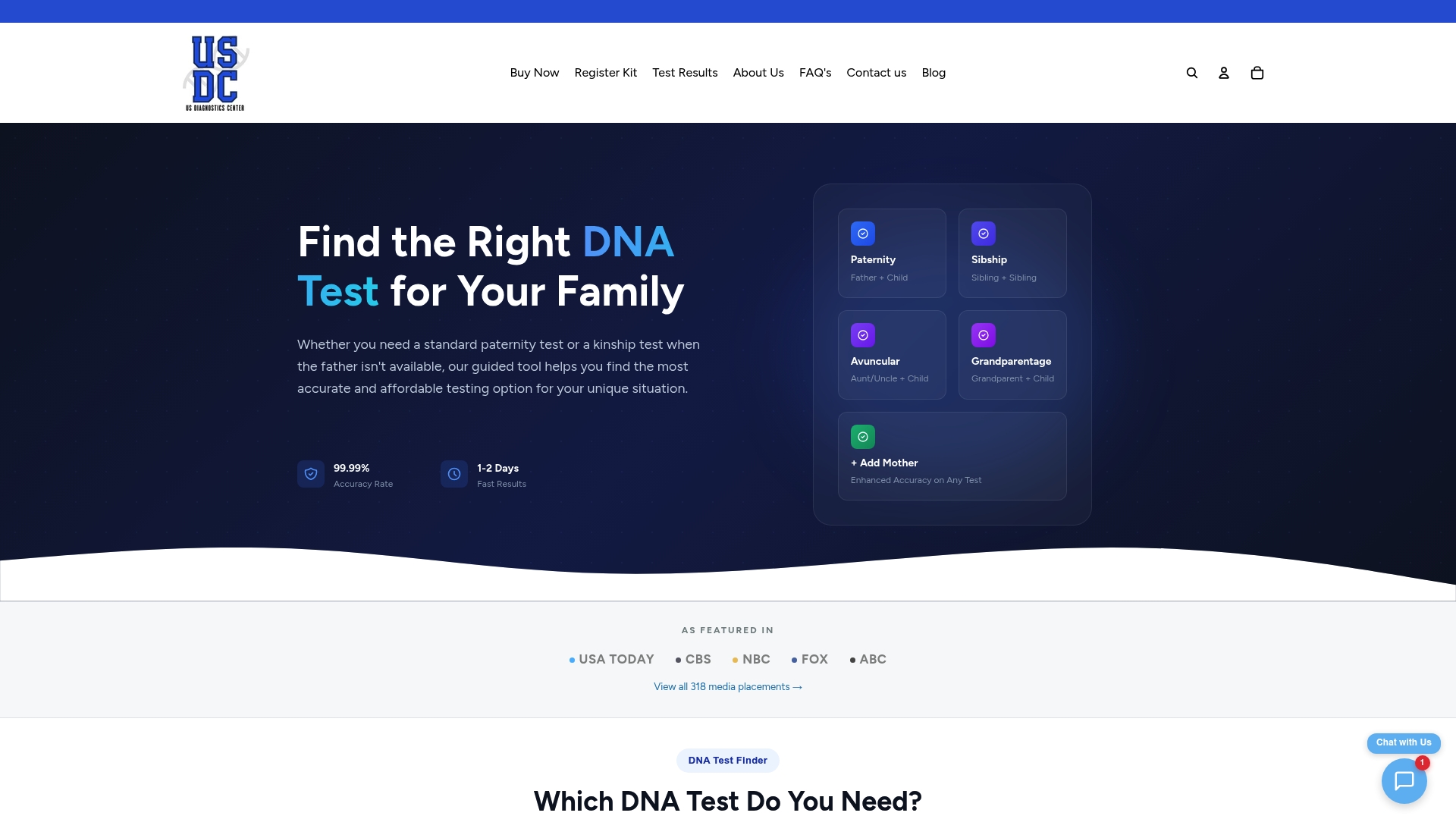
- Guided selection matches your situation to the correct kit before you pay for the wrong one.
- Included return shipping means the envelope for sending your sample back is already in the box.
- Expedited processing is available for anyone who needs faster answers, on top of the standard turnaround.
If you already know which relationship you need to test, the home DNA tests collection lists current kits and pricing so you can order directly and start the process today.
Sources
- Informed Consent — NHGRI
- If DNA test kits are on your holiday shopping list — FTC
- FTC finalizes order with 1Health.io over charges it failed to protect privacy and security of DNA data — FTC
This article is general information, not a substitute for advice from a qualified doctor. Consult a qualified healthcare professional about your own circumstances before acting on anything here.
FAQ
What is the difference between a personal-use kit form and a legal DNA form?
A personal-use kit form records your identity, the relationship being tested, and your consent for a private result, while a legal form must meet a court or agency’s evidentiary standards, including verified identity and chain-of-custody documentation. Personal-use kits from US Diagnostics Center are not court-admissible and are not intended to replace that process.
Do I need a witness to sign a personal-use kit consent form?
Most personal-use kits only require the donor’s signature, and a witness is generally only needed for a legal, court-admissible test rather than an at-home kinship kit. Check your specific kit’s instructions, since requirements can vary slightly between test types.
How long does it take to get results from a home DNA kit?
Lab processing for a personal-use kinship kit generally takes 2 to 3 business days once the sample arrives, with the full order-to-results timeline typically running 7 to 10 business days including shipping. Expedited processing is available for customers who need faster results.
Can I test a family member without telling them?
Testing another adult without their knowledge is risky and may be restricted depending on your state, and ethical guidance consistently recommends getting informed written consent before collecting anyone’s sample. Documenting that consent protects you and preserves trust within the family.
What does “up to 28 markers” mean on a kinship test?
Marker count refers to how many genetic locations the lab compares between participants, and testing up to 28 markers generally increases statistical confidence in the result compared to fewer markers. It does not change how you fill out the consent form, only how thorough the underlying comparison is.
Recommended
- Home DNA Test vs Legal DNA Test: How to Choose (Framework)
- Court-Admissible DNA Testing Benefits for U.S. Families
- Paperwork, Not Science: Why U.S. Legal DNA Profiles Pass in Court
- Only Clinician Ordered DNA Tests Get HIPAA Protection in the U.S.
This article is part of our Understanding DNA Testing: How It Works and What to Expect guide.


0 comments