

A legal DNA profile is a laboratory report generated from samples collected under documented chain of custody and processed by an accredited lab, and it is the only type of DNA result courts reliably accept for parentage or identification disputes. You need one for parentage litigation, criminal identification, and probate or forensic cases. A consumer home kit will not hold up under a judge’s scrutiny.
TL;DR:
- Courts require authorized chain-of-custody procedures and evidence from accredited labs for DNA test admissibility in legal disputes.
- Home DNA kits are generally not accepted in court due to lack of documented chain-of-custody and supplier verification.
- DNA profiles used legally are based on PCR-STR analysis, with at least 28 markers tested, and require validation and accreditation.
- A probability of parentage at or above 99% is typically sufficient to establish legal parentage, while lower match probabilities can be contested.
- The process for court-ordered testing involves filing a petition, serving respondents, attending a hearing, and delivering witnessed sample collections with official documentation.
Table of Contents
- How Do Courts Decide Whether DNA Evidence Is Admissible?
- Who Can Request a Court-Ordered DNA Test?
- Why Home DNA Kits Don’t Hold Up in Court
- What Standards Make a DNA Profile Legally Reliable?
- How to Read a DNA Test Report Without a Law Degree
- How Long Does Legal DNA Testing Take, and What Does It Cost?
- Can You Challenge or Overturn a DNA Parentage Result?
- What Legal Uses Does DNA Profiling Have Beyond Paternity?
- The Gap Between What This Process Promises and What It Delivers
- If You Need a Court-Admissible Test: Services and Next Steps
- Primary Sources and Standards
- Sources
- FAQ
How Do Courts Decide Whether DNA Evidence Is Admissible?
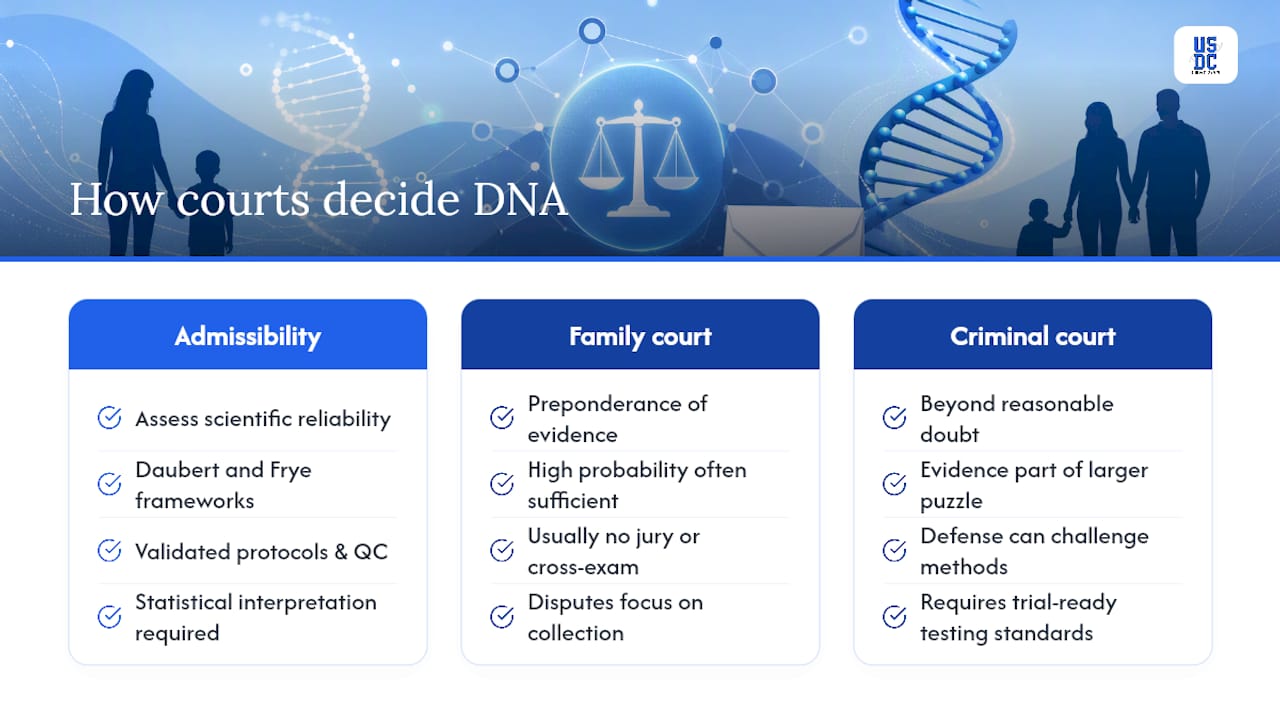
Courts do not accept a DNA result just because a lab produced it. Judges evaluate whether the underlying method is scientifically reliable and whether the person presenting the results can explain and defend the methodology under questioning. This standard traces back to reliability tests used across federal and state courts, generally built around the Daubert and Frye frameworks for expert testimony, and PCR based short tandem repeat (STR) typing has cleared that bar so many times it is now treated as a universally accepted method for identity testing in American courtrooms.
That acceptance is not automatic for every report that lands on a judge’s desk, though. A lab still has to show its work. Courts want validated protocols, documented quality control, and a statistical explanation of what the match actually means, not a bare “match” or “no match” conclusion. A profile presented without a likelihood ratio or random match probability attached is the kind of submission a defense attorney will attack first, because the discriminating power of a match has to be quantified for the evidence to carry real weight.
Civil family court and criminal court apply DNA evidence differently, and the distinction matters for anyone trying to understand what “admissible” actually means in their situation.
In a paternity or parentage case, the standard of proof is “preponderance of the evidence.” A DNA report showing a high probability of parentage is often enough, on its own, to resolve the legal question in one hearing. There is usually no jury, no cross examination of a forensic scientist, and no dispute over the science itself. The fight, when there is one, tends to be about whether the sample was collected properly, not whether STR typing works.
Criminal cases run on a much higher bar: “beyond a reasonable doubt.” A DNA profile matching a crime scene sample to a suspect might be one piece of a larger evidentiary puzzle, and the defense will often bring in its own expert to challenge collection procedures, lab methodology, or the statistical interpretation of a mixed sample. The same underlying science, PCR-STR profiling, gets treated with far more procedural weight in a criminal courtroom than in a family court hearing over child support.
Because civil proceedings so often settle “in the shadow of trial,” attorneys on both sides tend to insist on trial-ready testing standards even when the case never reaches a courtroom. That single fact explains why so many family law attorneys refuse to accept a home kit result as a starting point for negotiation. If the case might eventually need trial-grade evidence, both sides want the testing done that way from the start, according to legal analysis of DNA evidence standards.
Who Can Request a Court-Ordered DNA Test?
Getting a judge to order genetic testing is not automatic. A petitioner generally needs to show what courts call a “reasonable possibility” that the alleged biological relationship exists, a standard drawn from the framework most states have adopted under the Uniform Parentage Act. A mother, an alleged father, a child (through a representative), or a state child support agency can typically file, though the exact standing rules vary by state.
The process itself follows a fairly consistent sequence across jurisdictions, even though local rules and forms differ:
- File the petition. The petitioner submits a request to establish parentage, usually in family court, naming the parties and the relationship at issue.
- Serve the other party. The respondent has to be formally notified and given a chance to respond before the case moves forward.
- Attend the hearing. A judge reviews the petition, and if standing is established, issues an order compelling testing.
- Receive the testing order. This document specifies the approved lab, the collection method, and a compliance deadline. It typically names an accredited facility rather than leaving lab choice to either party.
- Complete witnessed collection. All parties report to the designated collection site with government-issued photo ID.
- Lab processes the sample and reports to the court. Results go to the judge and both parties, often with the statistical parentage probability included.
State child support agencies frequently manage this process directly when public assistance or support enforcement is involved, coordinating testing without either party having to hire separate counsel. Refusal to comply with a testing order rarely ends the case in the refusing party’s favor. Judges can enter a default judgment establishing parentage against the noncompliant party, or hold them in contempt of court, treating the refusal itself as evidence against their position.
If you are heading to a collection appointment under a court order, bring a government-issued photo ID, the court order or case number, and any paperwork the lab or agency sent confirming your appointment. Skipping any of these can delay the case by weeks.
Why Home DNA Kits Don’t Hold Up in Court
The gap between a mail-order paternity kit and a legal DNA profile is not the science. It is the paperwork and the witness. Courts routinely reject self-collected results because there is no way to verify who actually swabbed whom, and that lack of documented chain of custody is the single most common reason a judge throws out a submitted test.
- A home kit relies on the buyer to collect their own sample, unsupervised, with no ID check at the moment of collection.
- A legal test requires a neutral, trained collector to verify photo ID, witness the swab, and seal the sample in front of the participant.
- Home kits produce no signed chain-of-custody form tracking the sample from collection to lab.
- Legal tests generate a documented paper trail at every handoff, from collection through lab intake, which is exactly what a judge or opposing counsel will ask to see.
- Home kits are genuinely useful for personal peace of mind, family curiosity, or an informal conversation between two adults who trust each other.
None of that makes home testing worthless. It just means the result stops being useful the moment either party needs to enforce or dispute a legal relationship.
Pro Tip: If there’s any chance your case ends up in front of a judge, whether now or later, skip the home kit entirely and start with a court-admissible test. Paying for a legal-grade test twice, once informally and once for the court, costs more in time and money than doing it right the first time.
What Standards Make a DNA Profile Legally Reliable?
A legal DNA profile is built on PCR-STR analysis, which amplifies short, repeating sections of DNA called short tandem repeats at specific locations, or loci, on the genome. Each person inherits a distinct combination of repeat lengths at these loci from both parents, and comparing enough loci across two people produces a statistically overwhelming answer about whether they are related. The FBI’s Combined DNA Index System uses a defined set of core STR loci as the national standard for forensic identification and database matching, though relationship testing labs may examine additional markers beyond that core set for added discriminating power.
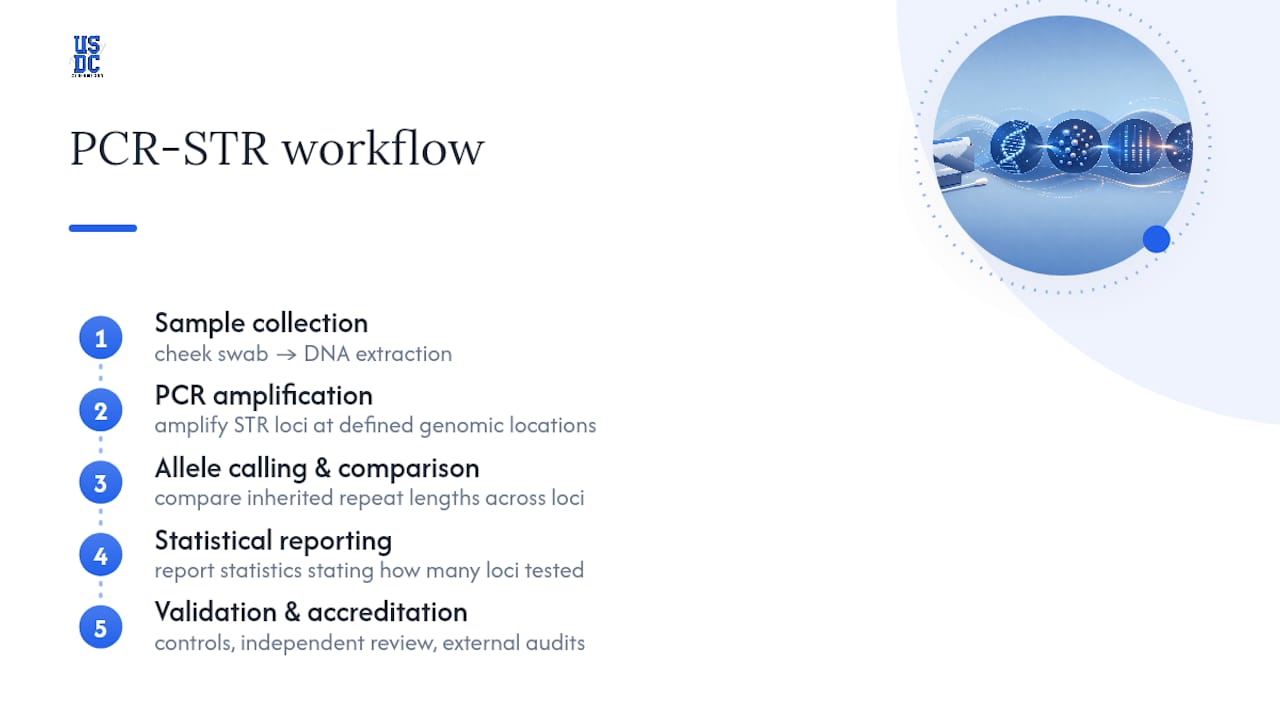
Marker count is where a lot of confusion creeps in. Testing means the lab examines a number of STR locations to compare between the tested individuals. More markers generally means finer discrimination between people who might otherwise share a few coincidental matches, which matters most in complex cases like distant kinship or degraded samples. Courts do not mandate a specific marker count by statute, but they do expect the lab’s methodology to be validated and its statistical reporting to reflect exactly how many loci were examined, a point documented extensively in forensic DNA reference literature.
Accreditation is the mechanism that ties all of this together for a court. For relationship testing, laboratories are commonly evaluated against AABB accreditation standards, the widely recognized benchmark in family law and immigration contexts. For forensic casework tied to CODIS, labs instead answer to the FBI’s forensic Quality Assurance Standards, which govern everything from evidence handling to analyst proficiency testing. Behind both standards sit the unglamorous but essential quality assurance steps: positive and negative controls run alongside every batch, independent technical review of results, and periodic external audits of the lab’s procedures. None of that shows up in the headline number on a report, but it is exactly what a judge’s law clerk will ask about if a result gets challenged.
How to Read a DNA Test Report Without a Law Degree
A parentage report boils down to one number that matters most: the probability of parentage. Modern STR testing across a robust marker panel commonly reports very high probabilities when parentage is confirmed, and most states treat a result at or above 99% as sufficient to create a rebuttable legal presumption of parentage. An exclusion, by contrast, is unambiguous: even one or two loci that fail to match between an alleged parent and child rule out the biological relationship entirely.
By the numbers: Courts in most states treat a probability of parentage at or above 99% as enough to establish a rebuttable legal presumption of parentage, shifting the burden to the other side to disprove the relationship.
The statistics behind that headline number, random match probability (RMP), likelihood ratios, and combined paternity index (CPI), describe how rare the observed genetic combination is in the general population. Misreading these numbers is called the prosecutor’s fallacy: treating “a 1 in 2 million match probability” as “a 1 in 2 million chance the person is innocent,” when those are not the same statement at all. A defense attorney or family law lawyer who understands this distinction can meaningfully challenge how a report’s numbers get presented in court.
Certain scenarios complicate interpretation no matter how good the lab is. Mixed samples with DNA from more than one person, low-template samples with too little genetic material, and testing involving close relatives or identical twins can all produce results that need extra scrutiny or a second analysis. If a report looks ambiguous or the stakes are high, requesting an independent lab review before the hearing is a reasonable and fairly common step.
How Long Does Legal DNA Testing Take, and What Does It Cost?
Lab processing on a legal or court-admissible test typically runs 2 to 3 business days once the sample reaches the facility, with total order-to-results time landing around 7 to 10 business days once collection scheduling and shipping are factored in. Expedited processing is usually available for time-sensitive cases, at an added cost, if a hearing date is approaching.
Cost allocation follows a fairly predictable pattern in most jurisdictions:
- The petitioner typically pays testing costs upfront when filing the request.
- A judge can order the losing party to reimburse those costs once parentage is established or excluded.
- Child support agencies sometimes cover initial testing costs for cases tied to public assistance.
- Expedited turnaround adds to the base price but can matter when a hearing date is fixed.
- Budgeting for both the base test and a possible reimbursement claim keeps expectations realistic going into a filing.
Knowing these ranges ahead of a court date prevents an unpleasant surprise when the invoice or the judge’s cost order arrives.
Can You Challenge or Overturn a DNA Parentage Result?
A DNA result at or above the 99% threshold creates a rebuttable presumption of legal parentage, not an unchallengeable fact. That distinction gives both sides real options, but the window to use them is narrower than most people expect.
Voluntary acknowledgments of paternity, the forms signed at a hospital or vital records office, typically come with a short rescission window, often 60 days in many states, during which either signer can withdraw without a court fight. After that window closes, disestablishing a previously acknowledged or adjudicated parentage generally requires fraud, duress, or a material mistake of fact, and courts apply these grounds narrowly. Statutes of limitation and specific procedural rules vary considerably by state, so anyone considering a challenge should check the actual statute in their jurisdiction rather than assume a national standard applies.
The most common successful challenges do not attack the science of STR typing itself. They attack the paperwork: gaps in chain-of-custody documentation, a collector who failed to verify photo ID at the appointment, or a lab error uncovered during independent review. Preserving a portion of the original sample and keeping every piece of chain-of-custody paperwork gives a party the ability to request independent verification later if a dispute arises. Anyone weighing a challenge should talk to family law counsel early, since the available remedy depends heavily on how much time has passed and which state’s rules apply.
What Legal Uses Does DNA Profiling Have Beyond Paternity?
Parentage disputes are the most common reason ordinary people encounter legal DNA testing, but the same underlying science supports several other legal contexts with meaningfully different rules.
Criminal identification relies on the FBI’s CODIS system, which matches forensic profiles collected from crime scenes or convicted offenders against a national database built on standardized core STR loci. Entry into CODIS requires the originating lab to meet forensic Quality Assurance Standards that go well beyond what a relationship-testing lab needs to satisfy, reflecting how much more is riding on accuracy in a criminal investigation.
DNA profiling also plays a role in probate and inheritance disputes, where establishing a biological relationship after someone has died can determine who inherits under a will or through intestate succession law. Immigration cases involving family-based petitions sometimes require DNA evidence to establish a biological relationship between a sponsor and a beneficiary, governed by the requesting agency’s own testing and documentation rules rather than family court procedure.
Each of these contexts imposes its own chain-of-custody, accreditation, and reporting requirements. A profile built to satisfy a family court’s parentage standard will not automatically satisfy a federal agency’s or a criminal court’s separate rules, which is exactly why confirming the requirement before testing begins saves everyone a repeat appointment.
The Gap Between What This Process Promises and What It Delivers
Most explainers treat legal DNA testing as a science problem. It isn’t. STR typing has been reliable for decades, and no competent lab is going to botch the chemistry. The failures that actually sink cases are procedural: a missed ID check, a broken chain-of-custody form, a party who used a home kit because it was cheaper and only learned it was worthless once opposing counsel objected.
The conventional advice, “get a DNA test,” skips the part that determines whether that test means anything to a judge. Priority one is procedure, not the marker count or the lab’s turnaround speed. Priority two is documentation, kept from the first phone call through the final report. Everything else, including which accredited lab you choose, matters far less than whether you treated this as a legal process from day one instead of a mail-order errand.
— Dr. Todd Lewis
If You Need a Court-Admissible Test: Services and Next Steps
US Diagnostics Center is built around the exact gap this article just walked through: the difference between a test that satisfies your curiosity and a test that satisfies a judge. US Diagnostics Center offers legal, chain-of-custody testing alongside kinship testing for sibling, grandparent, and aunt/uncle cases, with a guided selection tool that helps you identify the right test for your specific situation before you order anything.
Every legal test uses witnessed collection and documented chain-of-custody paperwork, tested against up to 28 markers, with lab processing in 2 to 3 business days and standard order-to-results turnaround of 7 to 10 business days. Expedited processing is available for hearing deadlines. The provider is currently pursuing AABB accreditation and does not yet hold it, so confirm your court’s specific lab requirements before scheduling collection. Home paternity, maternity, and kinship test pricing varies; refer to the provider’s website for current details. Tests are shipped with a prepaid return envelope.
If a court date is on the calendar, start by confirming your judge’s or agency’s lab and documentation requirements, then contact US Diagnostics Center’s legal DNA test collection team to arrange a witnessed appointment and request the chain-of-custody documentation your case will need.
Primary Sources and Standards
- Admissibility of DNA Evidence in Court
- How to Get a Court-Ordered DNA Test Step-by-Step
- NIJ: Admissible DNA Testing
- FBI Forensic Quality Assurance Standards
- Reference Guide on Human DNA Identification Evidence
- Child Support Handbook: Establishing Fatherhood
This article is general information, not a substitute for advice from a qualified lawyer. Consult a qualified legal professional about your own circumstances before acting on anything here.
Sources
- Admissibility of DNA Evidence in Court
- How to get a court-ordered DNA test step-by-step - LegalClarity
- NIJ: Admissible DNA testing
- FBI Forensic Quality Assurance Standards
- Reference Guide on Human DNA Identification Evidence - NCBI Bookshelf
FAQ
What Is the Difference Between a Legal and a Non-Legal Paternity Test?
A legal test requires a neutral collector to verify photo ID and witness the sample collection, with documented chain-of-custody paperwork the whole way to the lab, while a non-legal or home test relies on self-collection with no witness or ID verification, which is why courts routinely reject home kit results as evidence.
Can DNA Profiling Be Used to Prove Paternity in Court?
Yes. A legal DNA profile showing a probability of parentage at or above 99% creates a rebuttable legal presumption of parentage in most states, which is often sufficient on its own to resolve a paternity case.
What States Allow Familial DNA Testing?
Familial DNA searching, a forensic technique used in criminal investigations to identify relatives of an unknown suspect through partial database matches, is permitted under varying rules across different states, and policies on when and how law enforcement can use it differ enough that anyone facing this issue should check their specific state’s current forensic guidelines rather than assume a uniform national rule.
Recommended
- Why Legal DNA Testing Has Strict Protocols Explained
- Court-Admissible DNA Testing Benefits for U.S. Families
- Why Court DNA Differs from Private Tests: A Clear Guide
- DNA Chain of Custody Explained: Court-Admissible (2026)
This article is part of our Understanding DNA Testing: How It Works and What to Expect guide.


0 comments