

The private DNA testing process works the same way regardless of the relationship you’re checking: you order the correct kit, collect buccal swabs from each participant, mail them back in the prepaid envelope, and wait for STR laboratory analysis. Most orders run 2 to 3 business days for lab processing and 7 to 10 business days from order to results. This guide covers at-home and private kinship testing only, not consular or immigration DNA collection.
TL;DR:
- Most testing processes take 7 to 10 business days from order to results, with 2 to 3 days for laboratory analysis after samples arrive.
- Buccal swabs are the preferred DNA collection method because they are painless, non-invasive, and account for over 97% of samples nationwide.
- Inconclusive results are often due to contamination, insufficient DNA, or limited markers, but labs can typically fix these issues with additional testing or markers.
- At-home tests are not legally admissible because they lack witness verification and chain-of-custody documentation required for legal or court cases.
- US Diagnostics Center offers kits priced from $79 for paternity with standard turnaround times and expedited options.
Table of Contents
- What Are the Steps in the Embassy DNA Process for At-Home Testing?
- Why Do Labs Use Buccal Swabs for DNA Collection?
- How Long Does STR Lab Analysis Take?
- How Do You Read a Paternity or Kinship Test Report?
- What Causes Inconclusive Results and How Do Labs Fix Them?
- Is an At-Home DNA Test the Same as a Legal Chain-of-Custody Test?
- What Do DNA Testing Experts Say About Reading Ambiguous Results?
- What Chain-of-Custody Procedures Apply to Formal DNA Collection?
- Do Courts and Agencies Accept Standard At-Home DNA Results?
- What Documents and ID Are Required for Formal DNA Testing?
- How Do You Schedule a Witnessed DNA Collection Appointment?
- Should You Choose an At-Home Test or a Legal Collection?
- Order Your At-Home DNA Test From US Diagnostics Center
- Sources
- FAQ
What Are the Steps in the Embassy DNA Process for At-Home Testing?
Before you buy anything, confirm which test matches your situation. A paternity duo covers father and child. A trio adds the mother for stronger statistical certainty. Sibling, grandparent, and aunt/uncle kits follow similar logic but require the correct combination of participants to produce a usable result.
Once you order, here’s what happens next:
- Kit arrives by mail. Inside you’ll find buccal swabs, written instructions, a consent form, and a prepaid return envelope.
- Check the contents before you start. Missing swabs or an unsigned consent form are the two most common reasons a sample gets delayed at the lab.
- Collect each participant’s sample separately. Follow the swab count and timing instructions exactly. Label every envelope with the participant’s name before you seal anything.
- Package and ship. Seal each participant’s swabs in their own labeled bag, then mail everything together using the prepaid envelope.
- Lab receives and logs the kit. This step, called accessioning, confirms the consent forms match the samples before testing begins.
- Analysis runs, then results post. You’ll typically get an email or account update once the report is ready.
A few things worth flagging:
- Kits ship with a prepaid return envelope. This is not “free shipping,” it’s a cost already built into the price you paid.
- Expedited processing can shorten the lab portion of the timeline, though it doesn’t change how fast collection and shipping happen on your end.
- Standard order-to-results timing is commonly 7 to 10 business days, with the lab itself needing 2 to 3 business days once your sample arrives.
Pro Tip: Take a photo of your labeled envelopes before sealing the outer package. If the lab ever calls with a labeling question, you’ll have a record of exactly what you sent.
Why Do Labs Use Buccal Swabs for DNA Collection?
Buccal swabs, the cotton-tipped sticks you rub against the inside of your cheek, are the standard collection method for relationship testing. They’re painless, require no needles, and hold up better in transit than blood samples. State Department guidance on DNA relationship testing confirms buccal swabs are preferred specifically because they’re non-invasive and easy to ship. Industry data backs that up at scale: buccal swabs account for more than 97% of samples submitted for relationship testing nationwide.
Getting a clean swab isn’t complicated, but a few habits make a real difference:
- Don’t eat, drink, smoke, or chew gum for 30 minutes before swabbing.
- Rub the swab firmly against the inside of your cheek for a full 30 seconds.
- Use every swab provided. If your kit includes two per person, don’t stop at one.
- Let swabs air-dry for a few minutes if instructions say so, then seal them in the provided packaging without touching the tip.
- Never let two participants’ swabs touch or share the same collection surface.
Mislabeled or improperly dried samples are the top reason kits get sent back for a second round. A lab may also request a different sample type, such as a different swab kit, if the original one arrives with insufficient material for testing.
Pro Tip: Label the swab handle, not just the outer envelope. Handles rarely get separated from their sample during lab processing, so that’s your best insurance against a mix-up.

How Long Does STR Lab Analysis Take?
Once your samples reach the lab, technicians extract DNA and run Short Tandem Repeat (STR) analysis, the same core technology used in forensic and paternity testing nationwide. STR testing looks at specific repeating sequences in your DNA that vary widely between individuals, which makes them useful for telling family members apart with statistical confidence.
Marker count matters here. Testing up to 28 genetic markers gives the lab more comparison points between participants, which increases the certainty of the final probability. Fewer markers can still produce a result, but the statistical confidence behind it tends to be lower.
Reputable labs also run contamination controls throughout the process:
- Extraction and amplification negative controls to catch outside DNA contamination.
- Positive controls to confirm the testing chemistry worked correctly.
- Physical separation between the areas where extraction, PCR setup, and amplified DNA handling happen, a standard practice in forensic protocols designed to prevent one sample from cross-contaminating another.
Timeline reality check: Lab processing commonly takes 2 to 3 business days once your sample is logged in. Add shipping time in both directions, and standard order-to-results typically lands at 7 to 10 business days. Expedited options shorten the lab’s portion of that window, not the mail transit on either end.
How Do You Read a Paternity or Kinship Test Report?
Your report will center on one number: the combined paternity index, sometimes shown as a probability of parentage percentage. This figure reflects how the statistical odds favor a biological relationship once all tested markers are compared against reference population data.
A few things to know when you open that report:
- A clear inclusion shows matching alleles at nearly every tested marker, producing a high probability of parentage, often expressed as a value approaching certainty.
- A clear exclusion shows multiple mismatched markers, which rules out the tested relationship.
- A single mismatched marker doesn’t automatically mean exclusion. It could indicate a rare mutation at that locus, and labs typically retest or add markers before drawing a final conclusion.
- Trio tests (both parents plus child) generally produce tighter statistical certainty than duo tests, since the mother’s profile helps the lab isolate which alleles came from the father.
- Kinship tests, like sibling or grandparent testing, work with less direct genetic overlap than parent-child comparisons, so results sometimes benefit from additional markers or extra family participants.
What Causes Inconclusive Results and How Do Labs Fix Them?
Most inconclusive results trace back to one of three issues, and labs have standard fixes for each.
- Contamination during collection. Touching the swab tip, letting samples touch each other, or improper drying can introduce outside DNA. Prevention starts with clean collection habits, not lab correction.
- Insufficient DNA quantity. When a sample yields low DNA, labs can concentrate the extract, apply high-sensitivity testing methods, or request a fresh sample rather than reporting an unreliable result.
- Reduced discrimination from close relatives or limited markers. Testing between closely related individuals, such as half-siblings or an aunt and niece, sometimes needs additional markers or extra family members tested to sharpen the statistical picture.
When results come back ambiguous, labs often duplicate the analysis or run a confirmatory test on a second sample rather than issuing a single, unverified report.
Pro Tip: If your first kinship test result feels inconclusive, ask whether adding another relative, like a known sibling or grandparent, to the test would strengthen the statistics before you assume the test failed.
Is an At-Home DNA Test the Same as a Legal Chain-of-Custody Test?
No, and this distinction matters more than most people realize before they order. At-home tests are collected by you, at home, with no witness verifying your identity or the collection itself. Results are typically delivered privately through an online account or email.
Legal, or chain-of-custody, testing works differently: it requires ID verification, a witnessed collection, and sealed handling all the way to the lab. That documentation trail is what courts and government agencies require to accept a result as evidence.
A few practical notes:
- If you need a result for court or an immigration case, don’t rely on a standard at-home kit. Request a legal collection service instead.
- Your kit’s prepaid return envelope covers standard shipping, but it’s smart to use tracking and keep your receipt regardless.
- Most accredited labs run both types of testing but won’t represent an at-home result as chain-of-custody compliant without the documented witnessed process behind it.
What Do DNA Testing Experts Say About Reading Ambiguous Results?
Dr. Todd Lewis notes that ambiguous results usually come down to statistics, not lab error: a single mismatched marker rarely means exclusion, and adding a relative or requesting extra markers often resolves the uncertainty faster than retesting from scratch.
A few operational facts worth knowing before you order:
- USDC's home paternity test can analyze up to 28 genetic markers when the case warrants it.
- Standard lab processing runs 2 to 3 business days, with 7 to 10 business days typical from order to results.
- Expedited options are available for readers on a tighter timeline.
- The site’s guided test selection tool helps you pick the right kinship test based on which relatives are available to participate.
— Dr. Todd Lewis
What Chain-of-Custody Procedures Apply to Formal DNA Collection?
Chain-of-custody procedures exist to remove any doubt about whose sample is whose and how it traveled from collection point to lab. The process starts with identity verification, typically a government-issued photo ID checked against the person being swabbed.
A trained collector, not the participant, performs or directly witnesses the swab collection itself. That collector then seals the sample in front of the participant, signs and dates the seal, and completes documentation that travels with the kit rather than being mailed separately. The sample goes straight into a secured shipping process, often hand-delivered to a courier or tracked through a controlled chain rather than dropped in a regular mailbox.
Every handoff, from collector to shipping carrier to lab intake, gets logged. That paper trail is the entire point: it proves nobody could have swapped, tampered with, or mislabeled the sample between collection and analysis.
This is fundamentally different from the at-home process described earlier in this guide, where you collect your own sample unsupervised and mail it yourself. That’s perfectly appropriate for personal clarity or family curiosity. It does not meet the documentation standard that courts, government agencies, or formal legal proceedings require. If your situation involves any official use, chain-of-custody collection isn’t optional; it’s the only version of testing that will hold up to scrutiny. For any official use, work with a provider specifically credentialed for court-admissible legal testing.
Do Courts and Agencies Accept Standard At-Home DNA Results?
Generally, no. At-home DNA test results are built for personal answers, not legal proceedings. Because there’s no witness verifying who provided the sample, courts and government agencies typically won’t accept an at-home report as evidence in custody disputes, inheritance claims, or immigration cases.
Legal acceptance hinges entirely on the collection method, not the accuracy of the underlying science. The STR technology behind a $79 at-home paternity test and a witnessed legal collection is often identical. What differs is the documentation proving the sample came from the person named on the report. Without ID verification and a witnessed collection, even a perfectly accurate result carries no evidentiary weight in a courtroom or with an immigration officer.
This is why it’s worth being honest with yourself about the purpose of your test before you order. If you’re settling a personal question, curiosity about a sibling relationship, or peace of mind about a paternity situation, an at-home kit answers that question completely and privately. If there’s any chance the result needs to satisfy a judge, attorney, or government agency down the road, ordering the wrong type of test wastes both your time and your money. You’d need to start over with a properly witnessed legal collection, which adds weeks to a timeline you may not have to spare.
What Documents and ID Are Required for Formal DNA Testing?
Formal, witnessed DNA collection requires more paperwork than an at-home kit, and knowing what to prepare in advance saves a wasted appointment.
Every participant typically needs a current, government-issued photo ID, a driver’s license, passport, or state ID card. The collector checks this against the name on the consent form before any swab touches a cheek. A signed consent form is required from every adult participant, and a parent or legal guardian must sign on behalf of any minor being tested.
Some situations call for supporting documentation beyond the ID and consent form. If the test relates to an existing legal matter, such as a custody case or an estate dispute, you may need a copy of the relevant court order or attorney request naming the parties to be tested. For kinship tests involving extended family, such as an aunt, uncle, or grandparent, having birth certificates on hand for the participants can help establish the claimed family relationships being tested against.
None of this documentation is necessary for a standard at-home test, where you’re the one collecting your own sample and signing your own consent form without a witness present. That simplicity is exactly why at-home testing works well for personal questions but falls short of what formal proceedings require. If you’re unsure which category your situation falls into, it’s worth clarifying the intended use of your result before you schedule anything or place an order.
How Do You Schedule a Witnessed DNA Collection Appointment?
Scheduling a witnessed collection starts with identifying a facility or collector authorized to perform documented sample collection, since this isn’t something you do yourself at your kitchen table. Appointments are typically booked in advance, and most facilities ask you to bring your government-issued ID and any relevant paperwork the same day.
Arrive a few minutes early. Facilities usually need time to verify identification and complete consent paperwork before the actual swab collection begins. The collection itself takes only a few minutes: a trained professional swabs each participant’s cheek, seals the sample in front of you, and documents the entire process on the spot.
Multiple participants, such as a mother, child, and alleged father, often need to be scheduled together or at coordinated times if they’re not all available at the same location. Confirm this before your appointment so nobody shows up expecting a same-day result when a second participant still needs testing elsewhere.
Once collection is complete, the facility handles shipping to the lab as part of the documented chain, rather than handing you a prepaid envelope to mail yourself. That’s one of the clearest practical differences between this process and the at-home kits covered earlier in this guide: you’re a participant in a supervised procedure, not the person managing collection and shipping on your own.
Should You Choose an At-Home Test or a Legal Collection?
Most people asking a personal question, are we related, is this my biological child, don’t need anything beyond a standard at-home kit. Reserve legal or chain-of-custody testing for anything headed to court, an attorney, or a government agency.
Ask yourself three things: who needs to see this result, where will it actually be used, and how soon do you need an answer? If the answer touches a legal proceeding, skip the at-home kit and look into a chain-of-custody service instead.

Order Your At-Home DNA Test From US Diagnostics Center
US Diagnostics Center makes ordering the right test simple: the site’s guided test-finder walks you through a few questions about your situation, paternity, maternity, sibling, grandparent, or avuncular, and points you to the kit that matches.
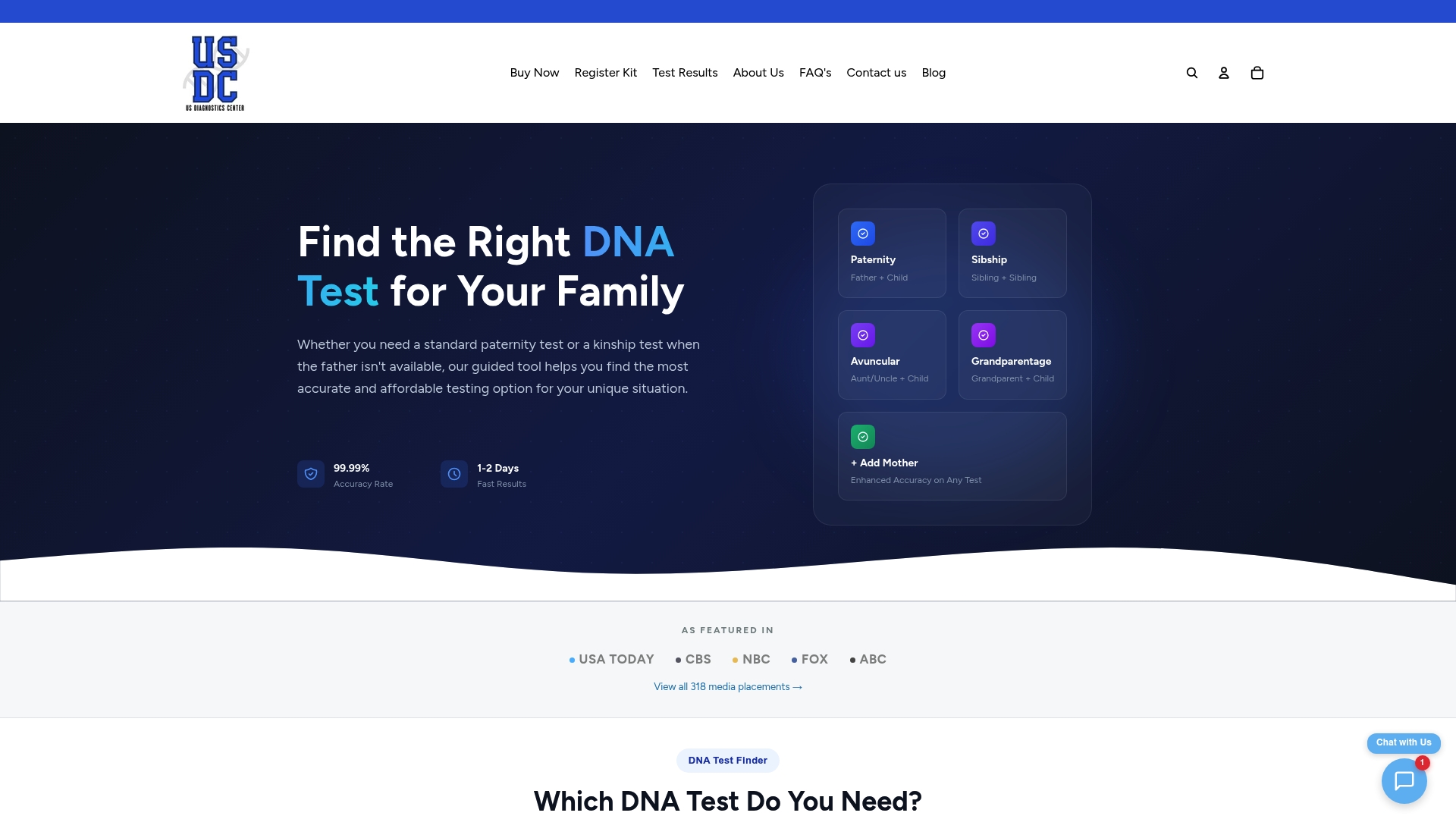
Home kits are priced clearly with no surprises at checkout. A Home Paternity Test Kit runs $79, a Home Maternity Test Kit is $129, and sibling, grandparent, and aunt/uncle kits are each $139. Each kit can analyze up to 28 genetic markers when the case warrants it and ships with a prepaid return envelope built into that price, not tacked on as an extra. Standard turnaround runs 2 to 3 business days for lab processing and 7 to 10 business days from order to results, with a Expedited processing is available during checkout when a family needs a faster answer.
If your situation is strictly personal, browse the home DNA test collection and place your order today. For situations requiring court-admissible documentation or specialized clinical testing, work with a provider specifically credentialed for those uses.
Sources
- DNA Relationship Testing Procedures — U.S. Department of State
- Short tandem repeat (STR) analysis in forensic DNA typing — PubMed Central
- Protocols for STR analysis — Forensic biology technical manuals
- AABB Relationship Testing technical report summary (2024)
- Mutation & paternity — National Institute of Justice
FAQ
What Is the Difference Between an At-Home DNA Test and a Legal One?
An at-home test is self-collected with no witness, while a legal test requires ID verification and a witnessed collection to be admissible in court or for immigration purposes. US Diagnostics Center offers at-home kits for personal clarity. For court or immigration cases requiring witnessed collection and documented chain-of-custody, work with a provider specifically credentialed for that use.
How Long Does a DNA Paternity Test Take?
Lab processing commonly takes 2 to 3 business days once your sample arrives, with standard order-to-results running 7 to 10 business days total. Expedited processing options can shorten the lab portion of that timeline.
How Many DNA Markers Are Needed for an Accurate Result?
USDC's home paternity test can analyze up to 28 genetic markers when the case warrants it. This increases statistical confidence compared to fewer-marker panels. More markers give the lab more comparison points to establish or rule out a biological relationship.
Can a Single Mismatched Marker Mean the Test Is Wrong?
Not necessarily. A rare mutation at one locus can cause a single discrepancy without ruling out the tested relationship, and labs typically retest or add markers before finalizing a conclusion.
How Much Does a Home Paternity Test Cost?
A Home Paternity Test Kit from US Diagnostics Center costs $79, while maternity testing is $129 and sibling, grandparent, or aunt/uncle kits are each $139. Each kit can analyze up to 28 genetic markers when the case warrants it and includes a prepaid return envelope.
Recommended
- U.S. Personal DNA Profile: Which Test to Order in 7–10 Days
- How Fast Home DNA Test Results Arrive: A Clear Guide
- Get Court Admissible Paternity Results in 7–10 Days After Birth (U.S.)
- Court Ready in 7–10 Days: U.S. Personal DNA Profile Uses
This article is part of our Paternity Testing: The Complete Guide guide.


0 comments