

The fastest way to get a reasonable breed guess is a photo app; the most reliable genetic ancestry answer comes from a consumer DNA test reviewed alongside a veterinarian. If you need to know your dog's breed for medical care, behavioral planning, or housing documentation, a DNA test plus a vet consultation is the appropriate path. Photo apps are useful for quick identification and casual curiosity, but they predict what a human observer would guess from appearance, not what the dog's genes actually contain.
When to pick each method:
- Quick ID in minutes (lost dog, shelter intake, casual curiosity): use a photo/AI app such as Dog Scanner or WhatBreedIsMyDog.com.
- Reliable genetic ancestry and breed breakdown: order a consumer DNA test such as Wisdom Panel or Embark, then discuss the report with your veterinarian.
- Medical screening, drug sensitivity, or breed-specific care: consult your veterinarian directly. AAHA notes that a significant portion of dog breeds carry one or more recognized genetic disorders, making breed identification clinically meaningful.
- Behavioral or adoption decisions: use DNA results as one input among several, not as a definitive label.
Key Takeaways
Photo apps give a fast visual estimate; consumer DNA tests give a probabilistic genetic ancestry breakdown; veterinarians provide the clinical interpretation that makes either result medically useful.
| Point | Details |
|---|---|
| Photo apps are visual guesses | Dog Scanner and WhatBreedIsMyDog.com predict appearance, not genetics; useful for quick ID, not medical decisions. |
| DNA tests depend on reference panels | Results from Wisdom Panel or Embark vary by marker density and panel size; cross-lab differences are normal. |
| Visual ID has documented limits | Shelter staff matched complete primary and secondary breeds in only about 10.4% of dogs in a large genomic study. |
| Percentage bands guide interpretation | Treat 25%+ as a major contributor; treat results under 5% as low-confidence traces rather than identity-defining facts. |
| US Diagnostics Center for human DNA testing | For relationship DNA testing (paternity, kinship), US Diagnostics Center offers at-home DNA test kits with results in 7–10 business days. |
Where to read more
- AAHA Breed-Specific Considerations: clinical rationale for why breed matters in veterinary care and screening.
- PetsPal: How Do Dog DNA Tests Work?: plain-language walkthrough of the consumer DNA test workflow and percentage interpretation guidance.
- PMC Shelter Genomic Study: full data on visual ID versus DNA results across a large shelter population.
- Cornell Canine DNA Testing: balanced overview of what DNA tests can and cannot tell you, with guidance on veterinary use.
- JAVMA Review on Canine Genetic Testing: peer-reviewed analysis of cross-lab variation, reference-panel limitations, and appropriate use of consumer tests.
Table of Contents
- How can I tell the breed of my dog using a photo app?
- How do consumer dog DNA tests actually work?
- Photo apps vs. DNA tests vs. veterinarian: which method fits your goal?
- How to read breed percentages and what "trace" results actually mean
- Step-by-step: ordering and collecting a dog DNA test correctly
- When breed identification affects your dog's care
- What research says about visual ID versus DNA testing
- DNA testing for human relationships: a different kind of answer
- Sources
- FAQ
How can I tell the breed of my dog using a photo app?
Most photo-based breed identification apps use trained image classifiers, not genetic analysis. The model learns from thousands of labeled breed photos and predicts which breed a human observer would most likely assign based on visible features: coat texture, ear shape, muzzle length, body proportions. According to an AJVR commentary on AI-based breed identification, these tools are limited to visual pattern matching and cannot substitute for genetic or medical decisions.
Apps and services worth trying
Dog Scanner is available on the Apple App Store and Google Play. It returns top visual breed matches with confidence scores and handles mixed-breed guesses. The app has a large consumer install base and a straightforward photo workflow: point, shoot, get results in seconds.

WhatBreedIsMyDog.com works as a browser-based alternative for owners who prefer not to install an app. Upload a photo, and the service compares it against a library of breed-typed images, returning ranked matches with confidence scores. Both tools are best treated as a starting point rather than a definitive answer.
Getting better results from a photo app
The quality of the photo matters more than most owners expect. A blurry or poorly lit image will push the classifier toward the wrong breed or return a low-confidence result.
- Use natural daylight or bright indoor light; avoid flash, which flattens features.
- Frame one dog per photo with no other animals, people, or distracting objects in the background.
- Capture a clear side-profile shot first, then add a front-facing photo and one showing the coat texture.
- Keep the dog still; motion blur is the single most common cause of low-confidence results.
- Avoid photos where the dog is wearing a collar, bandana, or clothing that obscures body shape.
Pro Tip: Run the same photo through two different apps and note where their top-match breeds overlap. Breeds that appear in both results are more likely to reflect a real visual characteristic, even if neither app is reading genetics.
Photo apps are useful for quick identification, shelter intake decisions, and satisfying curiosity. They are not appropriate for medical, legal, or insurance purposes, and they should not be used to predict behavior or health risk.
How do consumer dog DNA tests actually work?
Consumer dog DNA tests measure genetic markers, not appearance. The standard method is SNP (single-nucleotide polymorphism) microarray genotyping, which checks thousands of specific positions across the dog's genome. Embark's technical resources explain that the microarray reads each SNP, and the resulting profile is then compared against a reference panel of known-breed samples using supervised admixture models to estimate ancestry proportions. Microarray genotyping has become the dominant consumer method because it balances cost, throughput, and the number of markers needed for reliable ancestry inference; whole-genome sequencing produces more data but is rarely necessary for routine breed breakdowns.
The process from swab to report
- Order the kit. Choose a test that lists its reference panel size and whether health screening is included. Kits from Wisdom Panel and Embark are among the most widely used consumer options in the United States.
- Collect the sample. Swab the inside of the dog's cheek with the provided brush, following the manufacturer's instructions for duration and number of swabs.
- Return the sample. Seal the swab in the provided container and mail it to the lab.
- Lab processing. DNA is extracted from the cheek cells, then genotyped on a microarray. PetsPal's overview of the consumer workflow describes this as the standard path: cheek swab, extraction, genotyping, reference-panel comparison, report generation.
- Ancestry inference. The dog's SNP profile is compared to the company's reference panel of breed samples. The algorithm assigns breed proportions based on how closely the dog's markers match each reference population.
- Report delivery. Results typically arrive as a breed percentage breakdown, sometimes with trait predictions and optional health variant screening.
| Process step | What the owner does | What the lab produces |
|---|---|---|
| Sample collection | Cheek swab, 30–60 seconds | Biological material for extraction |
| DNA extraction | Nothing | Purified DNA from cheek cells |
| SNP genotyping | Nothing | Thousands of marker readings |
| Reference-panel comparison | Nothing | Breed proportion estimates |
| Report generation | Review online portal | Breed breakdown, traits, health variants |
Reference panels and why results vary across labs
The accuracy of a breed ancestry report depends directly on the reference panel: the collection of known-breed DNA samples the company uses for comparison. A breed that is absent or underrepresented in that panel will either be misassigned to a related breed or absorbed into a generic category. The JAVMA review on canine genetic testing notes that consumer test results vary between labs because accuracy depends on marker density, reference-panel composition, and company-specific algorithms. Two tests from different companies on the same dog can return meaningfully different breed percentages for this reason.

Health and trait screening, when included, identifies whether the dog carries specific genetic variants associated with disease risk or physical traits. Cornell's guidance on canine DNA testing is direct: DNA tests can inform disease risk screening and breed health management, but interpretation requires veterinary context. A positive variant result does not mean the dog will develop a condition; penetrance, environment, and other factors all matter.
Photo apps vs. DNA tests vs. veterinarian: which method fits your goal?
Choosing the right method:
- Need an answer in minutes? A photo app is the practical choice, with the understanding that it is a visual estimate.
- Want to know genetic ancestry and potential health markers? A consumer DNA test from Wisdom Panel or Embark, followed by a conversation with your veterinarian, gives the most complete picture.
- Dealing with a medical concern, drug sensitivity question, or breed-specific screening need? Book a veterinary appointment. DNA results can inform that conversation, but they do not replace clinical judgment.
- Budget is a constraint? Photo apps are free or low-cost. Consumer DNA tests range from roughly $70 to $200 depending on the kit tier and whether health screening is included.
How to read breed percentages and what "trace" results actually mean
PetsPal's guidance on percentage interpretation offers a practical framework:
- 25% and above: a major genetic contributor; treat this breed as meaningfully present.
- 10–25%: a meaningful contributor that likely influenced the dog's traits and health predispositions.
- 5–10%: plausible but less certain; worth noting, not worth overweighting.
- 1–5%: interesting but low-confidence; the reference panel may not have enough samples of that breed for a reliable call.
- Under 1%: generally treated as statistical noise.
Common misinterpretations to avoid:
- Treating a 3% "trace" result as a definitive part of the dog's identity.
- Assuming breed label predicts behavior. Temperament is shaped by genetics, early socialization, training, and environment together.
- Ignoring the reference-panel caveat: if a breed is underrepresented in the company's database, its contribution may be absorbed into a related breed or listed as "supermutt."
- Comparing results across two different companies and expecting them to match precisely. They often do not, for the reasons the JAVMA review describes.
A large shelter genomic study published in PMC found that shelter staff matched at least one DNA-identified breed in roughly two-thirds of dogs, but matched both primary and secondary breeds in only about 10.4% of cases. Those figures illustrate why visual estimates, whether from a person or an AI, capture only part of the genetic picture.
Step-by-step: ordering and collecting a dog DNA test correctly
Getting a clean sample is the single most controllable factor in result quality. Contamination from food residue, other dogs' saliva, or improper swab handling can degrade the DNA and force a retest.
- Choose the right kit. Confirm the test covers the breeds you are most curious about and check whether health screening is included if that matters to you. Wisdom Panel and Embark both publish information about their reference panels.
- Order and receive the kit. Standard delivery takes a few days. The kit will include swabs, a collection tube or envelope, and return shipping materials.
- Prepare your dog. Withhold food, water, and treats for 15–30 minutes before swabbing. This removes organic material that can contaminate the sample.
- Collect the swab. Rub the brush firmly against the inside of the cheek for the full time specified in the instructions, typically 30–60 seconds. Most kits require two swabs from different cheeks.
- Seal and return. Place swabs in the provided container immediately, seal it, and mail it using the included return envelope.
- Wait for processing. Lab processing typically takes 2–4 weeks from the date the lab receives the sample. Results are usually delivered through an online portal.
- Review with your vet. If the report includes health variant results or you have medical questions, bring the report to your veterinarian before making any care decisions.
Pro Tip: In a multi-dog household, swab one dog at a time and wash your hands between collections. Cross-contamination from a second dog's saliva on the swab is a common cause of unexpected or mixed results.
If results seem inconsistent with the dog's known history or the report flags a health variant, contact the company's customer support first. For clinical interpretation, your veterinarian is the appropriate resource.
When breed identification affects your dog's care
Knowing a dog's breed, or likely breed mix, has practical consequences in several areas of care and daily life.
- Veterinary screening: certain breeds carry elevated risk for specific conditions. Boxers and Doberman Pinschers have documented cardiac predispositions; large and giant breeds face higher orthopedic risk. AAHA's guidance on breed-specific considerations supports recording breed information to guide screening and diagnostics.
- Drug sensitivity: dogs with the MDR1 (ABCB1) gene mutation, common in herding breeds such as Collies and Australian Shepherds, can have severe adverse reactions to certain antiparasitic and chemotherapy drugs. A DNA test that identifies herding breed ancestry is a reasonable prompt to discuss MDR1 testing with your veterinarian.
- Behavioral planning: breed ancestry can inform training approaches and exercise needs, though it should not be used to predict individual temperament. A dog with significant herding breed ancestry may show strong chase or eye instincts; that is useful context, not a behavioral sentence.
- Shelter adoption labeling: shelter staff routinely assign visual breed labels that influence adoption rates and public perception. The shelter study cited above shows those labels are often incomplete. Prospective adopters benefit from treating visual labels as estimates.
- Housing and insurance: some landlords and insurers apply breed restrictions. A DNA report may support a conversation about a dog's actual ancestry, though policies vary widely and a DNA result is not universally accepted as documentation.
Cornell's guidance is clear that DNA test results should be used alongside veterinary care, not as a replacement for it. On privacy: consumer genetic companies store DNA profiles and breed data. Before ordering, review the company's privacy policy to understand how your dog's genetic data may be used, shared, or retained.
What research says about visual ID versus DNA testing
The evidence on visual breed identification is consistent and worth understanding before placing too much weight on any single method.
Most mixed-breed dogs carry multiple small breed contributions rather than a single dominant ancestry, which is why visual guesses so often capture only one piece of the picture.
The JAVMA review reinforces a related point: experts advise building a proactive health and behavioral profile for the individual dog rather than searching for a single "correct" breed label, because reference panels and database limitations make exact ancestry a probabilistic estimate. A DNA report is a useful tool, not a definitive identity document.
UC Davis veterinary guidance adds that misinterpreting genetic risk without professional counseling can produce unnecessary anxiety or incorrect medical decisions. The appropriate use of a DNA report is as one input into a broader clinical and behavioral picture, reviewed with a veterinarian.
A practical stance on combining these tools
Photo apps, DNA tests, and veterinary assessments answer different questions, and the most useful approach treats them as complementary rather than competing. An app gives a fast visual estimate that is good enough for casual identification or shelter intake. A DNA test provides a probabilistic genetic ancestry breakdown that is meaningful for health planning and breed-specific care, particularly when the report includes health variant screening. A veterinarian provides the clinical context that neither tool can supply on its own.
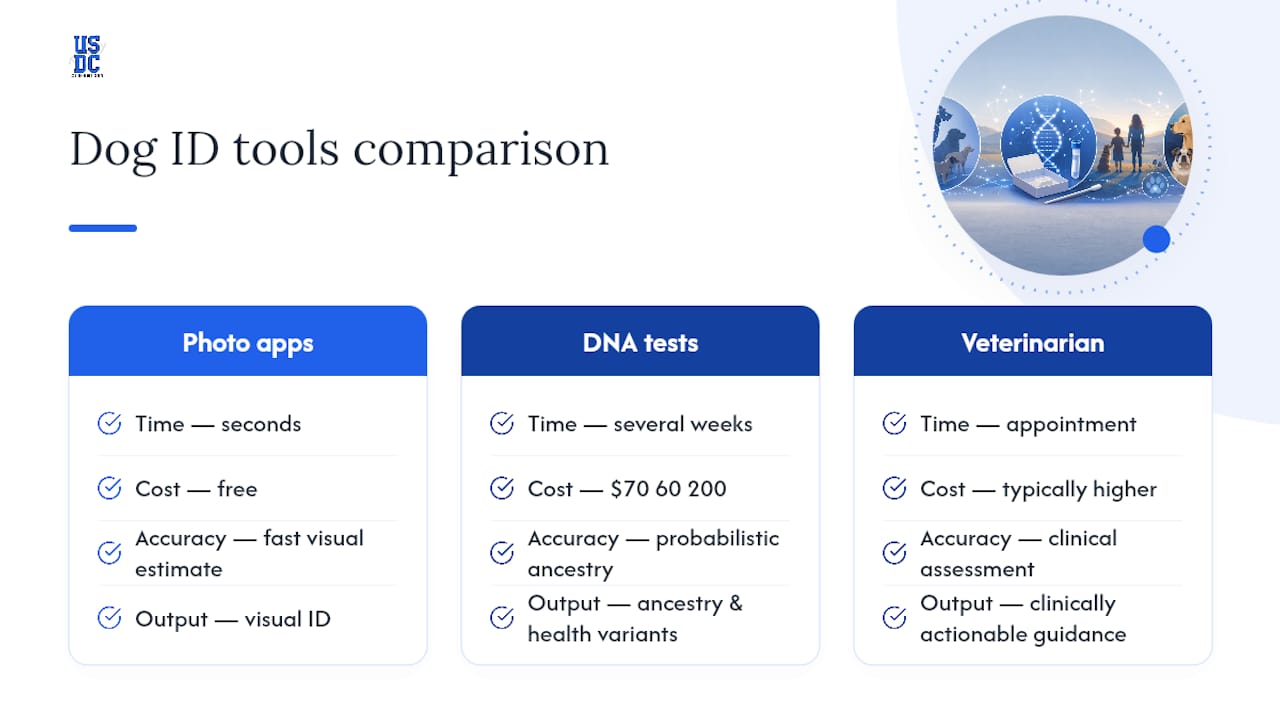
The cost-versus-value trade-off is straightforward: photo apps cost nothing and take seconds; consumer DNA tests cost $70–$200 and take several weeks; a veterinary consultation costs more but produces clinically actionable guidance. For most owners, the right sequence is app first, DNA test if ancestry or health matters, vet for anything medical. On data privacy, reading the privacy policy before ordering a DNA test is a reasonable step, given that genetic profiles are stored and potentially shared with research partners.
DNA testing for human relationships: a different kind of answer
Dog breed DNA tests and human relationship DNA tests share the same foundational technology, but they serve entirely different purposes. If you have been researching how genetic testing works and find yourself curious about human kinship testing, such as paternity, maternity, sibling, or grandparent relationships, US Diagnostics Center offers a direct path to those answers.
US Diagnostics Center provides at-home DNA test kits for paternity, maternity, sibling, grandparent, and avuncular relationships. The collection process is the same cheek-swab method described throughout this article: collect samples at home, return them using the prepaid envelope included with the kit, and receive results within 7–10 business days. For situations requiring court-admissible documentation, US Diagnostics Center also offers legal DNA tests with chain-of-custody collection. US Diagnostics Center is BBB Accredited with an A- rating. To find the right test for your situation, visit usdiagnosticscenter.com.
Sources
- Breed-Specific Considerations - AAHA
- How Do Dog DNA Tests Work? - PetsPal
- Breed identification in shelter dogs: comparison of visual assessment and DNA testing (PMC)
- Benefits of canine DNA testing | Cornell University College of Veterinary Medicine
- How Do Dog DNA Tests Work? - Embarkvet
FAQ
Is there an app to identify your dog's breed from a photo?
Yes. Dog Scanner, available on the Apple App Store and Google Play, and WhatBreedIsMyDog.com, a browser-based service, both identify breeds from uploaded photos and return ranked matches with confidence scores. These tools use image classifiers, not genetic analysis, so results are visual estimates rather than ancestry data.
Can Google identify my dog's breed?
Google Lens can return breed suggestions for a dog photo by matching it against its image index, but it is not a dedicated breed-identification tool and does not provide confidence scores or mixed-breed breakdowns. A purpose-built app like Dog Scanner or a consumer DNA test will give more structured results.
How accurate are dog DNA tests compared to visual identification?
Consumer DNA tests are substantially more accurate for ancestry than visual assessment. A large shelter study found that staff matched both the primary and secondary DNA-identified breeds in only about 10.4% of dogs. DNA test accuracy still varies by company depending on reference-panel size and marker density.
What breeds can Dog Scanner identify?
Dog Scanner's breed library covers several hundred recognized breeds and returns top visual matches for mixed-breed dogs as well. The exact number of breeds in its database is not publicly listed, but the app handles both purebred and mixed-breed identification through its image classifier.
When should I consult a vet about my dog's breed results?
Consult your veterinarian whenever a DNA report includes health variant results, when you are considering changes to medication or screening based on breed ancestry, or when breed-specific drug sensitivities such as the MDR1 mutation are flagged. Cornell and AAHA both recommend using DNA results as a supplement to veterinary care, not a replacement for it.
Recommended
- DNA Testing for Immigration: At-Home Kinship Tests Explained | USDC
- Why Home DNA Differs from Legal Tests: A Clear Guide | USDC
- DNA Test for Personal Knowledge: What You Need to Know | USDC
- How to Do a DNA Test: A Complete Step-by-Step Guide | USDC
This article is part of our Understanding DNA Testing: How It Works and What to Expect guide.


0 comments