

In the United States, a parent or lawful guardian generally may consent to a paternity test for a minor, and courts or child support agencies can compel testing in many contested cases. Home kits confirm biology for personal purposes, but a case headed to court or a state agency requires a test collected under chain of custody rules. The rest of this guide explains why, and what to do in each scenario.
TL;DR:
- Courts and child support agencies can order paternity testing for minors without parental consent in contested or support cases, provided legal procedures are followed.
- A legal guardian or court-appointed guardian ad litem can consent to testing with proper identification and court documentation, while informal caregivers must obtain guardianship beforehand.
- Chain of custody procedures, including witness collection and sealed samples, are essential for tests to be admissible in court or agency hearings; home kits lack this documentation.
- State procedures and deadlines for objecting to paternity acknowledgment vary, so parents should consult local laws and verify all documentation before testing.
- Refusing consent may lead to court-ordered testing and possible legal consequences, with agencies able to petition courts if necessary to establish paternity.
Table of Contents
- How consent works for a minor’s paternity test
- Who can sign: mother, father, guardian, or guardian ad litem
- When a court or child support agency can order testing without consent
- Home kit or legal test: which one actually holds up
- What chain of custody actually requires
- State differences and the federal rules behind them
- Steps to get a paternity test for a minor
- How refusal to consent gets handled
- What parents get wrong about paternity and consent
- Choosing the right test through US Diagnostics Center
- Sources
- FAQ
How consent works for a minor’s paternity test
The default rule is straightforward: a parent or legal guardian provides consent for a child under 18. Testing facilities and laboratories will not proceed on a minor without that consent from someone who can document the relationship, because a signature alone does not establish legal authority.
When someone other than a biological or legal parent wants to authorize testing, such as a grandparent, stepparent, or foster parent, the lab or agency will typically ask for court paperwork or written proof of guardianship before collection. This is standard practice reflected in state child support agency procedures, including guidance published by the Indiana Department of Child Services.

A minor’s own consent rarely factors into paternity testing before age 18, though state law can set different thresholds for related medical decisions. Facilities sometimes ask for a child’s assent, meaning the child’s verbal agreement to participate, even though legal consent still comes from the adult responsible for them.
Parents preparing for a test should expect the process to touch on:
- Who has legal authority to sign for the child, and what documentation proves it
- Whether the test is for personal information or intended for court or agency use
- Whether both parents need to be involved, or whether one parent’s consent is sufficient under state law
Our related guide on child DNA test consent covers additional scenarios parents commonly encounter.
Who can sign: mother, father, guardian, or guardian ad litem
Before scheduling a test, it helps to know exactly who counts as an authorized signer and what they should bring.
- A biological or adoptive parent with legal custody can typically consent alone, though some labs request both parents’ consent for a home test even when only one is required by law.
- A legal guardian appointed by a court can consent and should bring the guardianship order along with government-issued photo identification.
- A guardian ad litem, appointed specifically to represent a child’s interests in a court case, can authorize testing tied to that proceeding and should carry the appointment order.
- A caregiver without legal custody, such as a grandparent raising a grandchild informally, generally cannot consent until a court grants guardianship or the child’s legal parent signs off.
Hospitals, child support offices, and testing sites verify identity against government ID and cross-check any guardianship or court documents presented at collection. A birth certificate lists who is recorded as a parent, but it does not always reflect legal parentage. Voluntary acknowledgments and court adjudications are separate legal processes with different effects, a distinction covered in more detail in our piece on documents courts accept as legal proof of paternity.
Pro Tip: Bring two forms of ID and any court paperwork to the appointment, even if the facility didn’t ask for it in advance. Missing documentation is one of the most common reasons testing gets delayed.
When a court or child support agency can order testing without consent
Federal law sets a floor that every state must meet. Under 45 CFR § 302.70, states must have procedures allowing genetic testing to establish paternity through a child’s 18th birthday, and those procedures must address how objections to test results are handled and when a written report becomes admissible without additional testimony. Guidance from the Administration for Children and Families clarifies how these federal rules interact with state presumptions of paternity and voluntary acknowledgments, including how objection deadlines affect whether a test result can be challenged at a hearing.
In practice, this federal framework gives IV-D child support agencies and family courts authority to order testing even when a parent does not voluntarily agree. Common triggers include:
- A contested paternity claim where one party denies the alleged relationship
- A child support action where establishing legal paternity is a prerequisite to an order
- A parent who is unreachable or unwilling to sign, prompting the agency or court to step in directly
When an agency or court orders testing, the parent named in the case typically receives formal notice and a window to object or request a hearing before the order becomes final. Miss that window, and the state’s written test report can become admissible on its own, without a lab technician testifying in person.
Home kit or legal test: which one actually holds up
The right test depends entirely on what the result needs to do. A home kit answers a personal question. A legal test produces evidence a court, school, or government agency will accept.
The difference comes down to chain of custody. A legal test uses a neutral third party to verify each participant’s identity, witness the sample collection, and seal the sample before it ever reaches the lab. That documented chain is what makes the result trustworthy as evidence, because it closes the gap between who provided the sample and whose name appears on the result.
Home kits, collected without a witness present, do not carry that same documentation. Government and court ordered paternity tests use strict chain of custody protocols precisely because unwitnessed collection leaves room to question whose sample was actually tested. That is why many courts decline to accept results from a self-collected kit unless additional steps are taken to verify the sample afterward, a limitation explained further in this overview of at-home test limitations.
Before deciding, ask:
- Will this result need to go before a judge, agency, or school for benefits or custody purposes?
- Do both parties agree to participate, or is one likely to dispute the outcome later?
- Is there a deadline tied to a court filing or agency request?
If the answer to any of these points toward a legal need, a witnessed collection through an accredited chain of custody process is the appropriate route, not a self-collected kit. Our article on what courts require from paternity tests walks through the request process in more detail.
What chain of custody actually requires
Chain of custody is the paper trail that connects a specific person to a specific sample, from collection through lab analysis to the final report. It typically includes these steps:
- Identity verification against government issued photo ID for every adult participant
- A neutral, trained collector who witnesses each swab and confirms no tampering occurred
- Sample sealing in the collector’s presence, with a signed chain of custody form documenting the handoff
- Laboratory receipt logs and internal documentation showing the sample was never left unaccounted for
One documented signature at every handoff point is the standard courts look for. A break anywhere in that chain, an unwitnessed swab, an unsealed envelope, a missing signature, gives the opposing party grounds to challenge the result later.
Laboratories used for legal testing typically maintain accreditation and internal documentation standards that support this process. When a result is disputed, courts may require a retest through a court designated laboratory rather than accepting a private lab’s report without question.
State differences and the federal rules behind them
States build their own procedures on top of the federal floor set by 45 CFR § 302.70, which means the details parents actually deal with can vary quite a bit from one state to the next.
Areas where states commonly diverge include:
- How long a parent has to formally object to voluntary acknowledgment of paternity before it becomes legally binding
- Whether a presumption of paternity, such as one arising from marriage at the time of birth, requires additional steps to overturn
- Who bears the initial cost of testing in an intergovernmental IV-D case, a question shaped by the Intergovernmental Child Support Final Rule governing cost recovery between responding and initiating states
- Administrative procedures for identity verification and testing costs within state supported programs, as illustrated by rules like Oregon’s paternity establishment procedures
ACF and OCSE guidance shapes how these state level rules get written and interpreted, but the specifics still differ enough that a parent in one state cannot assume the same deadlines or cost rules apply elsewhere. Anyone navigating a contested case should check their own state’s IV-D agency website or consult a family law attorney licensed in that state before assuming a rule from a neighboring state applies to their situation.
Steps to get a paternity test for a minor
The path forward depends on whether both parents agree.
- If both parents agree: choose a legal test provider that offers witnessed collection, confirm both parents’ identification documents match what the lab requires, and schedule an appointment at an approved collection site rather than collecting samples at home.
- If one parent refuses: contact your state’s IV-D child support agency to request assistance opening a paternity case, or file a petition with family court asking for an order compelling testing.
- Gather documentation in advance: government ID for all adult participants, the child’s birth certificate, and any existing court orders or case numbers tied to a pending support or custody matter.
- Track your timeline: IV-D cases typically move through agency channels first, with court involvement only if the agency cannot resolve the matter or a parent contests the results after receiving notice.
Costs vary depending on the path taken. A private legal test arranged directly with a lab is a fixed private fee, while IV-D agency involvement may shift some or all of the cost onto the state initially, with recovery from a parent handled under the cost rules described in the ACF guidance above.
Pro Tip: Start with your state’s IV-D agency if you cannot afford a private legal test. Agencies have established procedures for exactly this situation and can direct you to an approved lab.
How refusal to consent gets handled
When a parent refuses to consent to testing, the other parent is not without options, but the process runs through the agency or the court rather than around it.
- IV-D agencies can petition a court for an order compelling a reluctant parent to submit to testing, and in many IV-D cases the state initially covers the cost, subject to later recovery from a parent under applicable cost rules.
- Courts have several remedies available depending on state law, including a direct order to submit to testing, contempt findings for continued refusal, or evidentiary consequences that can work against the refusing parent in the underlying case.
- If a parent cannot be located or refuses to engage entirely, courts may appoint a guardian ad litem to represent the child’s interests and help move the matter forward.
Parents facing resistance should document every request for cooperation in writing, keep copies of any correspondence, and consult a family law attorney or their local IV-D office rather than attempting to resolve a refusal informally.
What parents get wrong about paternity and consent
A birth certificate is often mistaken for proof of legal paternity, but the two are separate. A father listed on a birth certificate through a hospital acknowledgment has not necessarily gone through the legal adjudication process that a contested case requires, and that gap catches parents off guard when a custody or support matter arises later.
My advice to parents weighing which test to order is simple: if there is any chance the result will need to support a court filing, a benefits application, or a disputed custody matter, choose a witnessed, chain of custody collection from the outset. Ordering a home kit first and trying to upgrade to legal status afterward rarely works, because the missing documentation cannot be recreated after the fact. Review the consent requirements for your specific situation before scheduling any appointment, and when the stakes involve a court or agency, treat the collection process as part of the evidence itself, not a formality.
— Dr. Todd Lewis
Choosing the right test through US Diagnostics Center
Parents who need clarity without the guesswork of researching lab requirements themselves can use the guided test finder at US Diagnostics Center to match their situation to the appropriate test.
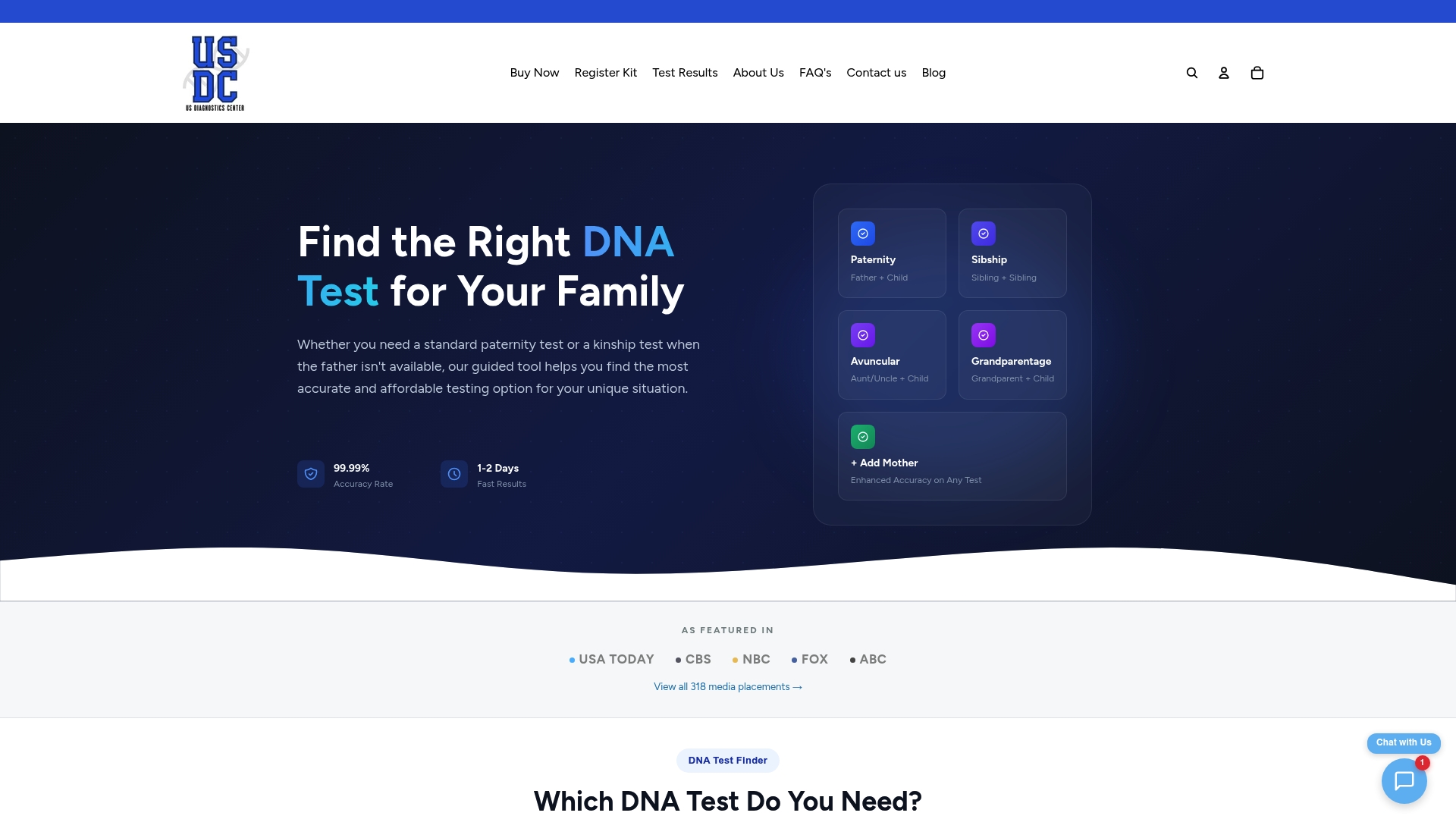
For personal, non-court situations, the Home Paternity Test Kit is priced at 79 USD, analyzes up to 28 markers, and includes a prepaid return shipping envelope so there is nothing extra to arrange after collection. Lab processing takes 2 to 3 business days, with standard order-to-results turnaround of 7 to 10 business days, and expedited Next-Day Results are available for an additional fee through the test finder tool for families who need answers faster.
For situations that may end up before a court or agency, the legal DNA test collection outlines the witnessed collection process intended to support evidentiary use. Reviewing your documentation needs against the guidance above before ordering will save time either way. Start by using the test finder to identify the right option for your family’s situation.
This article is general information, not a substitute for advice from a qualified lawyer. Consult a qualified legal professional about your own circumstances before acting on anything here.
Sources
- 45 CFR § 302.70 - Required State laws. | e-CFR | LII / Legal Information Institute
- Action Transmittal AT-94-06 Responses Part 3 | Administration for Children and Families (ACF)
- Genetic Testing Procedures | Indiana Department of Child Services
FAQ
Can a 12-year-old take a DNA test?
Yes, but a parent or legal guardian must provide consent since minors cannot legally authorize testing on their own. The child may be asked for verbal assent, but legal consent still comes from the adult responsible for them.
Is it illegal to DNA test a child without parental consent?
Testing a minor without consent from a parent or legal guardian, or without a court order, generally violates the consent requirements labs and agencies follow, though the specific legal consequences depend on your state’s family law. A court order or IV-D agency action can substitute for parental consent when a parent refuses or cannot be located.
Can I do a DNA test without the mother’s consent?
If you have legal custody or are the child’s legal guardian, you generally do not need the other parent’s consent to order a home test, though some labs still request both parents’ cooperation. If the result needs to be used in court, a contested case typically requires either agreement from both parties or a court order compelling participation.
Can a minor get a DNA test?
A minor can be tested, but consent must come from a parent, legal guardian, or a guardian ad litem appointed by a court, not the minor themselves. Testing facilities verify who is signing before collection proceeds, and documentation like guardianship orders may be required if someone other than a parent is authorizing the test.


0 comments