

When a deadline is driving your decision, the test you need depends on what happens to the result afterward. If a court, custody hearing, support agency, or birth-certificate office will ever see the paperwork, you need a legal chain-of-custody test, not an at-home kit. If you only need an answer for yourself, an at-home informational test is faster to order and cheaper to run, and it will get you a reliable answer without any of the legal scaffolding.
Urgency affects testing options because it forces a tradeoff between speed and admissibility. Expedited lab processing can shrink the analysis window, but it cannot remove the identity verification, neutral collection, and sealed documentation that make a legal chain-of-custody test usable in court. Those steps take time no matter how fast the lab itself works.
Three things to do right now if a deadline is looming:
- Call a lab and ask directly whether the results need to be court-admissible, then book a neutral collector immediately if so.
- Ask about expedited processing options and get a written turnaround estimate, not a verbal guess.
- Confirm what paperwork (photo ID, consent forms, court order copies) each participant needs to bring before the appointment.
Pro Tip: If there's any chance you'll need the result for a legal filing later, order the legal test from the start. Once you're identified, chain-of-custody protocols apply even if a court hasn't asked for it, and there's no way to retroactively convert an at-home result into one.
Key Takeaways
Urgency changes which DNA test you should order because legal deadlines require chain-of-custody collection that no amount of lab speed can bypass.
| Point | Details |
|---|---|
| Legal vs. personal use | Court, custody, or agency deadlines require a legal chain-of-custody test; personal curiosity does not. |
| Paperwork drives delay | Scheduling collectors and completing consent forms usually take longer than the lab analysis itself. |
| Rush processing has limits | Expedited lab work speeds up analysis but cannot replace verified collection for legal admissibility. |
| Budget for the right tier | At-home kits start at $79; legal collection and rush fees add cost but buy admissibility and speed. |
| US Diagnostics Center's role | Offers at-home kits from $79, a guided test-selection tool, and expedited processing. |
Table of Contents
- Why Urgency Affects Testing Options and What Counts as a Deadline
- At-Home Kits vs. Legal Tests: What Actually Changes
- How Fast Can Expedited Processing Actually Get You Results?
- Your Step-by-Step Decision Checklist
- What Speed and Legal Documentation Cost
- Inside a Legal Collection Appointment
- What Can Go Wrong Under Deadline Pressure
- The Mistake I See Families Make Under Deadline Pressure
- How US Diagnostics Center Handles Urgent Testing
- Sources
- FAQ
Why Urgency Affects Testing Options and What Counts as a Deadline
Not every rushed request is a legal one, and mixing up the two categories is the single most common mistake families make under pressure. A deadline set by a court, a state child-support agency, or a vital records office is a legal deadline. A deadline you've set for yourself, like wanting an answer before a family gathering or before deciding whether to file for custody, is a personal one.
Legal deadlines typically come from:
- A signed court order or a pending custody or support hearing date.
- A birth-certificate amendment window at a state vital records office.
- A child-support enforcement agency requiring proof of paternity before adjusting payments.
- An adoption proceeding or other administrative process that requests DNA verification as part of its filing.
Personal urgency, by contrast, is about your own timeline. You want clarity before a conversation, a wedding, or a move. In that case, the difference between at-home and legal testing matters less, and speed and price matter more.
The U.S. Department of State is explicit that legal purposes require verified chain-of-custody testing, not consumer kits. Courts and support agencies operate under the same logic, even when their own guidance doesn't spell it out as clearly.
At-Home Kits vs. Legal Tests: What Actually Changes
The lab science behind a paternity or maternity test doesn't change much between an at-home kit and a legal test. What changes is everything wrapped around the sample. An at-home kit lets you swab your own cheek, seal the tube yourself, and mail it in. A legal test requires a neutral third party to check government-issued photo ID, witness the collection, complete consent forms, and seal the sample in a way that can be traced from swab to lab report.

That structure exists for a reason: there are two distinct categories of paternity testing, and you cannot upgrade an informational result into a legal one after the fact. If you guess wrong and choose the at-home path, you'll be starting over with a new legal collection.
| Feature | At-home informational test | Legal chain-of-custody test |
|---|---|---|
| Collection | Self-swab at home | Neutral collector, in person |
| ID verification | Not required | Government-issued photo ID checked |
| Documentation | Minimal, no legal forms | Consent forms, chain-of-custody seals |
| Court/agency acceptance | Not accepted | Accepted for legal purposes |
| Typical lab time | 2 to 3 business days | 5 to 7 business days once received |
Scheduling the collector and completing identity checks add days, not lab time. Cost differences come from that same collector network and the documentation overhead, along with fees for accredited handling. Before you order anything, run through this quick check:
- Will the result need to go to a court, agency, or vital records office at any point? Choose legal.
- Do you just need to know for yourself? An at-home kit is faster and cheaper.
- Are you unsure which one you'll need later? Choose legal now to avoid retesting.
How Fast Can Expedited Processing Actually Get You Results?
Lab analysis for a standard paternity or maternity test commonly completes in 2 to 3 business days after the lab receives your sample, and legal tests often run longer — typically 5 to 7 business days — because of the extra documentation review. What most people don't realize is that this lab window is usually the shortest part of the entire process, not the longest.
Where the time actually goes: shipping to the lab, scheduling a collector, and any agency routing routinely add more days than the analysis itself.
Expedited options exist for a reason, and they do work within limits. Rush processing can compress lab analysis to 1 to 2 business days for an added fee, and some providers offer mobile collectors who come to you rather than requiring an office visit. Ancestry-style testing, by contrast, rarely gets meaningfully expedited because of how those panels are processed, so don't expect rush pricing to apply there.
- Rush lab processing: shortens the analysis window, usually for a flat added fee.
- Mobile or same-day collectors: reduce scheduling delay but availability varies by region.
- Priority shipping: shaves a day or two off transit but doesn't touch chain-of-custody requirements.
Pro Tip: Ask the lab for a guaranteed turnaround in writing, including cutoff times for sample receipt. "Usually 2 to 3 business days" is not the same promise as "results by Thursday if we receive your sample by Monday."
Your Step-by-Step Decision Checklist
- Identify exactly who will see the result: yourself, a court, an agency, or a records office.
- If any legal or administrative body is involved, confirm you need a chain-of-custody test, not an at-home kit.
- Call the lab and ask whether they can meet your deadline, including expedited processing availability.
- Book the collection appointment for every required participant as soon as possible; availability tightens near deadlines.
- Choose shipping speed based on how much buffer you have before the deadline, not just the cheapest option.
Ask the lab or collector these questions directly:
- "Will these results be accepted by [the specific court or agency]?"
- "What is your guaranteed turnaround for expedited processing, in writing?"
- "What happens if a sample needs to be recollected? Does that reset the clock?"
Red flags that should push you toward legal testing even if you weren't planning on it: a court order already exists, you intend to amend a birth certificate, or a state agency has requested proof as part of a support case. In any of those situations, an at-home kit is the wrong tool regardless of how fast it ships.
What Speed and Legal Documentation Cost
At-home informational kits are the cheapest and fastest option when court acceptance isn't a factor. Legal tests cost more because they include a trained collector's time, notarized or witnessed paperwork, and lab handling that meets stricter documentation standards.
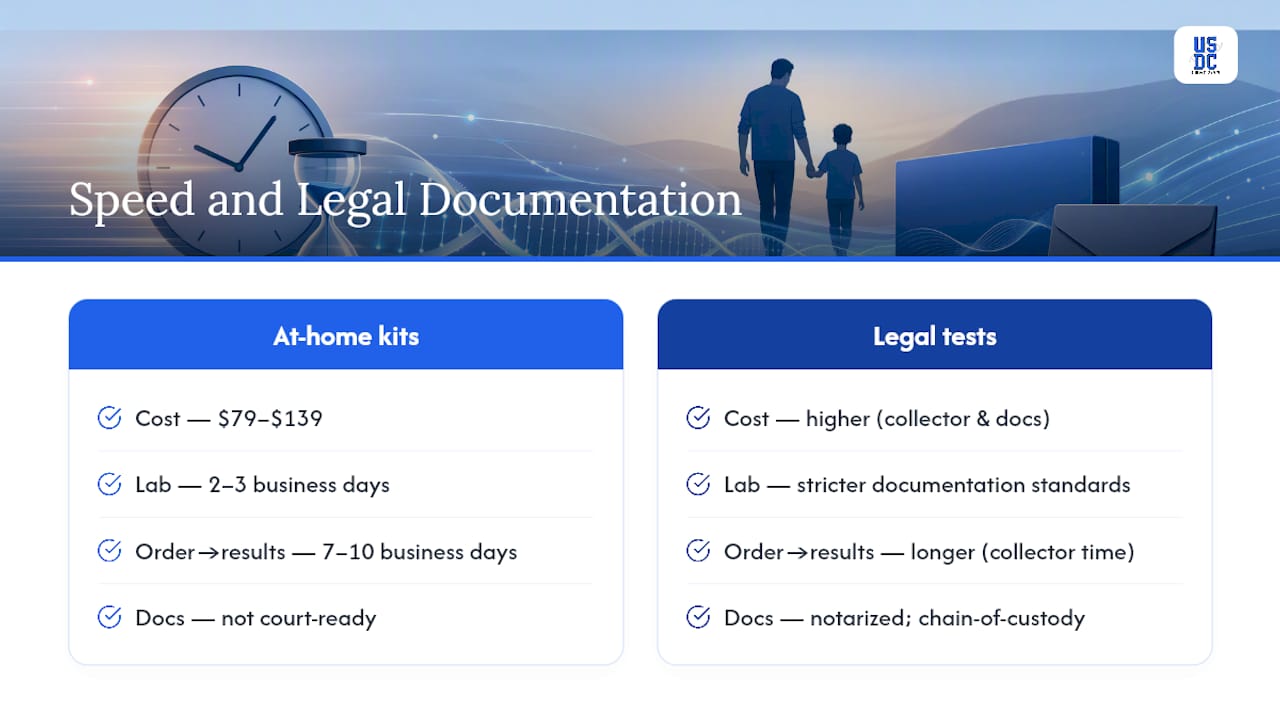
US Diagnostics Center lists home paternity kits at $79, maternity at $129, and sibling, grandparent, or aunt/uncle testing at $139, with lab processing commonly completing in 2 to 3 business days and standard order-to-results running 7 to 10 business days. Rush fees for expedited handling can vary widely depending on how fast you need the result and whether a mobile collector is involved.
Some fees are optional (priority shipping, mobile collection) while others are baked into legal testing by necessity (collector time, chain-of-custody documentation). Know which is which before you commit to a quote.
Inside a Legal Collection Appointment
Legal collection follows a set sequence designed to survive scrutiny later. Missing a step here is one of the most common reasons families end up rescheduling.
- The collector verifies government-issued photo ID for every adult participant.
- Everyone signs consent forms, and a parent or guardian signs for any minor.
- The collector documents the process, sometimes including photographs of the participants.
- Samples are sealed in front of the participant with tamper-evident seals.
- The sealed kit ships directly from the collection site to the lab, maintaining the documented chain.
Bring a valid photo ID for every adult being tested, and bring a copy of the court order or agency letter if one exists. If multiple participants are in different locations, call ahead to book collectors in each city at the same time rather than sequentially. Coordinating consent requirements for minors early avoids a last-minute scramble.
Common delays and how to dodge them:
- Missing consent signatures: confirm who needs to sign before the appointment, not during it.
- Wrong ID type: ask the collector exactly what qualifies as acceptable ID.
- Weak or contaminated swabs: poor sample quality can force a recollection that adds three to seven days.
What Can Go Wrong Under Deadline Pressure
Even a well-planned expedited order can hit snags that no amount of rush fee will fix. An uninvolved or uncooperative party can stall collection indefinitely. Lab backlogs during peak seasons slow turnaround regardless of your fee tier. Court scheduling operates on its own calendar, and if your case crosses jurisdictions, service of process and administrative routing can add weeks on top of the lab's own timeline.
There is no way to convert an at-home informational result into a legal one after the fact. If you tested at home and later discover you need court-admissible proof, you will need an entirely new legal collection, with a new sample, a new collector, and a new clock.
If a deadline is genuinely too tight, you have real options short of giving up. You can file a motion for continuance to push the court date. You can ask an agency about temporary administrative measures while testing is pending. You can also order rush processing and proactively notify the court or agency of the expected turnaround so the delay doesn't count against you unexpectedly. When a direct participant is unavailable, labs can sometimes test relatives instead, though grandparentage or avuncular results can be less definitive and may require additional markers.
The Mistake I See Families Make Under Deadline Pressure
Families under deadline pressure tend to optimize for the wrong variable. They chase the fastest possible kit rather than asking first whether the result needs to survive legal scrutiny. That single question should come before any conversation about turnaround time or price, because the answer determines which entire category of test you're allowed to use.
The pattern I'd call out from experience with these cases: people assume "legal" just means "more official," so they treat it as an upgrade they can add later if needed. It isn't. It's a different collection process entirely, done by a different person, documented in a different way, and it has to happen from the first swab, not retrofitted after results come back. If there's a court date, a support hearing, or an agency form anywhere on your horizon, that's the deciding fact. Speed is a secondary concern you solve after you've picked the right test category, not before.
How US Diagnostics Center Handles Urgent Testing
US Diagnostics Center is built for exactly the moment you're in: needing a fast, reliable answer without guessing which test category fits your situation. The guided test-selection tool walks you through your scenario, whether it's paternity, maternity, sibling, or grandparent testing, and points you to the right kit before you spend money on the wrong one.
Lab processing commonly completes in 2 to 3 business days, with a standard order-to-results window of 7 to 10 business days, and expedited processing is available for readers facing a tighter timeline.
If your deadline involves a court date, custody hearing, or agency filing, learn about legal DNA test collection options to arrange neutral, chain-of-custody collection. If you just need an answer for yourself, order directly from the at-home DNA test collection and get moving today.
Sources
- US-Citizenship DNA Testing - U.S. Department of State
- How to Get a Paternity Test: At the Hospital, at Birth, or Without the Father | Know Your Rights
- Time Needed for Paternity Test Results - Schwartz & Cohen Law
- Can You Rush Your DNA Test Results? | Talcada
If a court or agency has named a specific deadline in your case, contact the lab directly and confirm they can meet it before you place an order.
This article is general information, not a substitute for advice from a qualified lawyer. Consult a qualified legal professional about your own circumstances before acting on anything here.
FAQ
Can an at-home DNA test become legal evidence later?
No. An at-home informational test cannot be converted into a legal chain-of-custody test after the fact; you would need to redo the collection with a neutral third party.
How fast can I get court-admissible DNA results?
Lab analysis for legal tests typically takes 5 to 7 business days once samples arrive, but the full court-ordered process often runs four to eight weeks due to scheduling and administrative routing.
Does expedited processing help with legal deadlines?
Expedited processing can shorten lab analysis time but cannot remove the identity verification and documentation steps a legal test requires.
What does US Diagnostics Center charge for testing?
Home paternity kits are $79, maternity kits are $129, and sibling, grandparent, or aunt/uncle kits are $139, with lab processing commonly completing in 2 to 3 business days.
What is AABB accreditation?
AABB is an international standards-setting organization that accredits relationship testing laboratories. Accredited labs must meet rigorous requirements for personnel qualifications, quality systems, and chain-of-custody documentation. When a lab holds AABB accreditation, courts and agencies can verify that its testing procedures meet a recognized benchmark for accuracy and reliability.
Recommended
- Why Home DNA Test Timing Matters More Than People Think | USDC
- Home DNA Test vs Legal DNA Test: How to Choose (Framework) | USDC
- USDCTest | DNA Paternity Testing for Peace of Mind
- Why DNA Tests Beat Blood Tests for Relationship Proof | USDC
This article is part of our Understanding DNA Testing: How It Works and What to Expect guide.


0 comments