

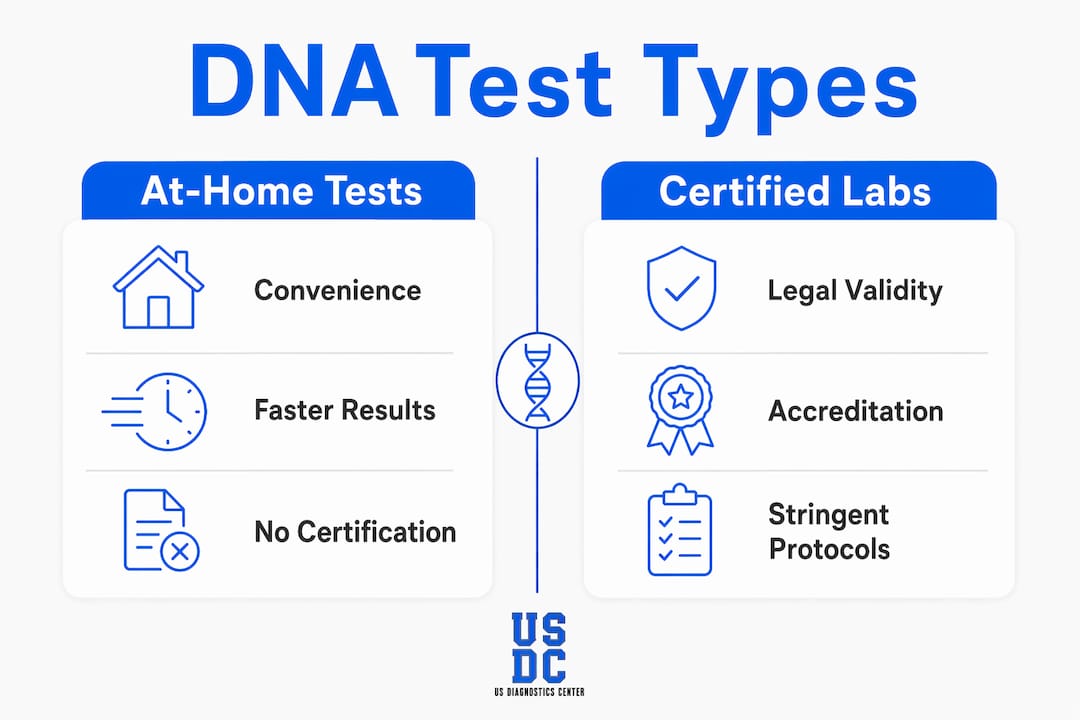
Home DNA testing has made relationship testing more accessible than ever — but the role of certified DNA labs has not shrunk. It has become more important. At-home DNA tests deliver scientifically reliable results for personal knowledge when processed by a qualified laboratory. Court-admissible or legally binding results are an entirely separate matter and require a different process altogether: witnessed sample collection, documented chain of custody, and an AABB-accredited facility. Collecting a cheek swab at home is only the first step. Without a certified lab handling the analysis under documented protocols and accreditation standards such as those set by the American Association of Blood Banks (AABB), results may be scientifically compromised and will carry no legal weight regardless of their biological accuracy.
Here is why certified labs remain essential even when sample collection happens at home:
- Chain-of-custody documentation tracks every sample from collection through reporting, which courts and agencies require to verify sample integrity.
- AABB accreditation confirms a lab meets the quality and interpretive standards necessary for relationship and kinship DNA analyses.
- Certified labs apply validated protocols, calibrated instruments, and staff competency evaluations that home collection alone cannot replicate.
- Without certified lab processing, results are often rejected by courts and immigration agencies regardless of the biological accuracy of the underlying data.
Why home DNA still needs certified labs: the core distinction
The difference between an at-home DNA test and a certified lab DNA test is not primarily about where the swab is collected. It is about what happens to that sample afterward, and who can verify every step of the process. Understanding how DNA testing works from collection through reporting helps clarify why lab certification matters so much.
At-home kits allow individuals to collect buccal (cheek) swabs without any witnessed verification. No third party confirms the identity of the person swabbed, and no documented record tracks the sample from collection to the lab. That absence of oversight is precisely what courts and federal agencies object to. Legal DNA tests — a separate category of testing not currently offered by USDC — require a witnessed collection, photo identification, and a documented chain of custody that follows the sample through every stage of analysis.
Certified labs also differ in how they interpret results. AABB-accredited facilities are the only labs in the United States that use formulae and statistical guidance specifically designed for parentage and kinship calculations. That interpretive expertise reduces the risk of incorrect relationship reporting, which a standard consumer kit cannot guarantee.
- At-home kits: no witnessed collection, no identity verification, no chain-of-custody documentation.
- Certified labs: witnessed or supervised collection, government-issued ID confirmation, documented sample tracking from receipt through reporting.
- Quality control: certified labs use validated testing platforms and undergo external audits; at-home kits have no equivalent oversight.
- Result interpretation: certified labs apply relationship-specific statistical formulas; consumer kits may report raw probability without expert review.
Pro Tip: Before ordering any DNA test, verify whether the processing lab holds current AABB accreditation by checking the public directory at aabb.org. This single step tells you whether results will meet the minimum standard for legal or immigration use — and whether the lab's interpretive methods are relationship-testing-specific.
Accuracy risks in at-home DNA sample collection
At-home sample collection introduces several accuracy risks that certified lab protocols are specifically designed to prevent. The most common problems are sample contamination, mislabeling, and sample switching, all of which occur because no trained professional supervises the collection process.
Contamination can happen when a person eats, drinks, or smokes before swabbing, or when the swab contacts surfaces other than the inside of the cheek. Mislabeling occurs when participants confuse their own samples with another person's, particularly in multi-party tests such as sibling or grandparent testing. Sample switching, whether accidental or deliberate, is possible when no witness is present to confirm identity. Certified labs minimize contamination risk through stringent environmental controls, staff training, and validated collection procedures.
The number of genetic markers analyzed also affects accuracy. Certified labs can test up to 28 markers, and expert interpretation of those markers reduces error margins in relationship testing. At-home tests may analyze fewer markers and lack the expert review layer that catches ambiguous results. USDC's home DNA tests analyze up to 28 genetic markers, giving personal-knowledge results a strong scientific foundation even when they are not intended for court use.
Common at-home sample collection risks and their consequences:
- Contamination: Foreign DNA on the swab produces unreliable or inconclusive results.
- Mislabeling: Swapped sample labels invalidate the test and require retesting.
- Improper storage: Heat or moisture degrades DNA before the sample reaches the lab.
- No identity verification: Without witnessed collection, there is no way to confirm whose DNA was actually submitted.
- Insufficient sample volume: Inadequate swabbing yields too little DNA for a conclusive result.
Legal implications: when courts require certified lab processing
Federal and state legal systems in the United States set clear requirements for DNA evidence, and those requirements center on certified lab processing. AABB accreditation is mandatory for all U.S. immigration cases, including visa, passport, and citizenship proceedings. Many state court systems impose the same requirement for child support, custody, and parentage determinations.

A critical legal distinction also applies here: biological parenthood and legal parenthood are not the same thing. Even if a DNA test correctly identifies a biological parent, that finding does not automatically establish legal parentage. Formal court steps such as signing a Voluntary Declaration of Parentage or obtaining a court order are still required. A private at-home test result, even a biologically accurate one, will not satisfy those procedural requirements.
DNA results from non-accredited labs or unverified sample collections are routinely inadmissible. Courts and agencies look at both the scientific result and the documented process that produced it. If the process cannot be verified, the result is treated as unreliable regardless of what it shows.
Legal criteria for DNA test admissibility in U.S. proceedings:
- AABB accreditation: Required for all federal immigration cases and most state court proceedings.
- Chain-of-custody documentation: An unbroken record from sample collection through final reporting.
- Witnessed collection: A neutral third party confirms the identity of each person tested.
- Accredited lab analysis: The testing facility must appear on the AABB-accredited facilities list at aabb.org/dna.
- Direct reporting: For immigration cases, results must be reported directly from the accredited facility to the relevant agency, as outlined by U.S. Citizenship and Immigration Services (USCIS).
Note: USDC currently offers home DNA tests for personal knowledge only. Court-admissible and immigration DNA testing are coming soon. If you have an active legal or immigration matter, consult a qualified legal professional about certified lab requirements in your jurisdiction.
How lab accreditation ensures reliable DNA results
AABB accreditation is the recognized standard for relationship DNA testing in the United States and is widely regarded as the global benchmark in this field. Its standards are frequently incorporated into other accrediting organizations' guidelines, reflecting the depth and rigor of its requirements. You can read a detailed overview of what AABB accreditation covers at USDC's AABB knowledge page.
Accredited labs undergo biannual inspections and proficiency testing, which involves correctly analyzing unknown samples on a periodic basis. Failure to pass proficiency testing directly affects a lab's accreditation status, creating a continuous accountability mechanism. Labs must also maintain documented protocols covering contamination prevention, instrument calibration, and staff competency evaluations.
AABB is also the only relationship testing accrediting body that provides specific formulae, interpretation guidelines, and statistical methods for calculating parentage and kinship relationships. That specificity matters because relationship testing is not the same as general DNA analysis. Kinship calculations require specialized expertise that general laboratory accreditation — such as CLIA certification or ISO 17025 — does not address on its own.
The table below shows how an AABB-accredited lab compares to a typical consumer kit lab across the quality dimensions that matter most for relationship testing:
| Quality Dimension | AABB-Accredited Lab | Standard Consumer Kit Lab |
|---|---|---|
| On-site inspection frequency | Biannual by AABB assessors | Not required |
| Proficiency testing | Blind unknown samples, periodic | Not required |
| Relationship-specific statistical formulas | Yes — AABB-provided guidelines | Varies; often general probability only |
| Director qualifications | Doctoral degree + 2 years relationship testing experience | Not standardized |
| Chain-of-custody documentation | Required and auditable | Not required |
| Instrument calibration records | Documented and verified | Not externally verified |
| Admissible for U.S. court/immigration | Yes (with witnessed collection) | No |
Lab quality protocols under AABB accreditation:
- Biannual on-site inspections by AABB assessors.
- Proficiency testing using blind unknown samples to verify analytical accuracy.
- Documented quality management systems covering all stages from collection to reporting.
- Staff competency evaluations and ongoing training requirements.
- Instrument calibration records and validated testing platform documentation.
- Director qualifications requiring a doctoral degree in a relevant scientific field and at least two years of relationship testing experience.
Pro Tip: Before selecting any lab for relationship DNA testing, verify its accreditation status directly at aabb.org/dna. If a facility does not appear on that list, it is not currently accredited, and its results will not be accepted for immigration or most court purposes.
Scenarios where home DNA test results fall short
Understanding the home DNA testing limitations in specific real-world situations clarifies why certified lab confirmation is not optional in many cases.
Child support and custody disputes. A parent who obtains a private at-home paternity test and wants to use it to challenge or establish child support obligations cannot rely on that result in court. California Courts' guidance makes clear that a DNA test done through a pharmacy or at-home kit will likely not be valid in court and will not be sufficient to establish or disestablish legal parentage. The court must order its own testing through a certified, accredited facility. At-home paternity tests — including USDC's home paternity test — are designed for personal knowledge, not legal proceedings.
Immigration petitions. Any person seeking to prove a biological relationship for a U.S. visa, passport, or citizenship case must use an AABB-accredited facility. U.S. Citizenship and Immigration Services (USCIS), passport agencies, and U.S. embassies will only accept results when the case is initiated by and reported directly from an AABB-accredited lab. An at-home test result submitted for an immigration petition will be rejected outright.
Disestablishment of paternity. If a man is already named as a legal parent in a court order and wishes to challenge that status based on DNA evidence, a private test is insufficient. Courts require a court-ordered test from a certified lab, and even then, the court may deny the request if the law already treats the person as a legal parent regardless of genetics.
New York State residents. The New York State Department of Health does not permit at-home DNA paternity tests at all. Residents must use an approved testing facility, making certified lab processing a legal requirement rather than a recommendation.
Grandparent and sibling relationship testing. These tests involve more complex kinship calculations than direct parentage testing. The statistical methods required to produce a reliable probability of relationship for grandparent or sibling pairs are specific to accredited labs that follow AABB's interpretive standards. A consumer kit analyzing fewer markers without expert review can produce misleading probability figures in these cases. US Diagnostics Center offers kinship DNA tests for sibling, grandparent, and aunt/uncle relationships processed under its current laboratory standards for personal-knowledge results.
Key Takeaways
Certified lab processing is legally and scientifically required for DNA test results to hold up in U.S. courts, immigration proceedings, and formal parentage determinations. Home DNA tests provide reliable personal-knowledge results when processed by a qualified lab — but they are not a substitute for legal testing in formal proceedings.
| Point | Details |
|---|---|
| AABB accreditation is mandatory | Federal immigration cases and most state courts require results from AABB-accredited labs only. |
| Chain of custody is non-negotiable | An unbroken, documented record from sample collection to reporting is required for legal admissibility. |
| At-home collection carries accuracy risks | Contamination, mislabeling, and lack of identity verification can compromise results without certified oversight. |
| Up to 28 markers improve reliability | Certified labs analyzing up to 28 genetic markers with expert interpretation reduce relationship testing errors. |
| Biological and legal parentage differ | A DNA result alone does not establish legal parentage; formal court steps are still required. |
| AABB vs. CLIA vs. ISO 17025 | AABB is the only standard that includes relationship-specific statistical formulas; CLIA and ISO 17025 alone are not sufficient for court or immigration DNA testing. |
FAQ
Do you need to be certified to do DNA testing?
For legal and immigration purposes in the United States, yes. AABB accreditation is required for any DNA test used in federal immigration proceedings, and many states require it for court-admissible results. Private, non-legal home DNA tests have no mandatory certification requirement, but results from non-accredited labs carry no legal weight.
Will a home DNA test hold up in court?
No. A DNA test conducted through an at-home kit will not be valid in court and will not be sufficient to establish or disestablish legal parentage, as California Courts' guidance confirms. Courts require testing ordered through certified, accredited facilities with documented chain-of-custody. Home DNA tests — including USDC's home tests — are for personal knowledge only.
Is DNA testing still legal in the United States?
Yes, DNA testing is legal throughout the United States, though individual states regulate how tests must be conducted for legal purposes. New York State, for example, prohibits at-home paternity tests and requires testing at an approved facility. For legal proceedings nationwide, AABB-accredited lab processing is the standard.
Which DNA test won't sell your information?
Privacy practices vary by provider and are governed by each company's terms of service rather than a universal standard. For legal DNA tests, results are typically reported only to the parties named in the case and the relevant court or agency. Reviewing a lab's data retention and sharing policies before testing is advisable, particularly for private (non-legal) home DNA tests where consumer data protections may differ.
What is the difference between AABB, CLIA, and ISO 17025 for DNA testing?
AABB accreditation is the relationship-testing-specific standard that covers parentage and kinship DNA analysis, including the statistical formulas and interpretive methods unique to these tests. CLIA (Clinical Laboratory Improvement Amendments) is a federal certification that governs clinical diagnostic labs broadly — it covers medical testing quality but does not include relationship-specific interpretive standards. ISO 17025 is an international quality management standard for testing and calibration laboratories in general. For DNA relationship testing in U.S. courts and immigration proceedings, AABB accreditation is the required standard; CLIA and ISO 17025 alone are not sufficient substitutes.
For private relationship testing, US Diagnostics Center offers home DNA tests for personal knowledge — including a home paternity test starting at $79, a maternity test starting at $129, and sibling, grandparent, and aunt/uncle tests starting at $139 — with results in several business days and a prepaid return shipping envelope included. Court-admissible and immigration DNA testing at USDC are coming soon. If you have an active legal or immigration matter, consult a qualified legal professional about certified lab requirements in your jurisdiction.
Recommended
- How Home DNA Kits Get Processed: A Clear Guide | USDC
- What Is a Legal DNA Testing Site? Your 2026 Guide | USDC
- Why Court DNA Differs from Private Tests: A Clear Guide | USDC
- Top 5 DNA Testing Misconceptions — Myths vs. Facts | USDC
This article is part of our Understanding DNA Testing: How It Works and What to Expect guide.


0 comments