

X chromosome testing is a targeted genetic analysis used to resolve kinship cases that standard DNA testing cannot settle on its own. It works best in female-line questions, such as a possible half-sister relationship, and in deficiency cases where the alleged father is deceased or unavailable and relatives must stand in for him. This test is not a replacement for autosomal testing. It is a supplementary tool, added when the family situation calls for it, and interpreted through a likelihood ratio that expresses how much more probable the claimed relationship is compared to a random match.
Labs run X-STR marker panels, sometimes covering 13 to 14 loci, and providers like US Diagnostics Center can process panels of up to 28 markers depending on the case. If your first-round results came back inconclusive, or your case involves sisters, a grandmother, or a missing father, the next step is usually to ask your lab whether X testing applies before you order anything else.
- Best for: father-daughter cases, deficiency cases, sister/half-sister comparisons, grandmother-granddaughter questions
- Not useful for: father-son disputes, routine paternity cases where autosomal testing already gives a clear answer
- Reported as: a likelihood ratio — expressed as a Combined Relationship Index (CRI) for kinship cases or a probability of parentage in deficiency paternity cases — not a simple yes/no result
Key Takeaways
X chromosome testing resolves kinship questions that autosomal DNA testing cannot settle, particularly in father-daughter, deficiency, and female-line cases, but it requires specialized statistical handling because of marker linkage.
| Point | Details |
|---|---|
| Supplementary, not standalone | X testing works alongside autosomal testing, not instead of it, for most kinship questions. |
| Inheritance drives usefulness | Fathers pass X only to daughters, making father-daughter and sister comparisons especially informative. |
| Linkage complicates the math | X markers sit close together, so labs need Bayesian models to calculate an accurate likelihood ratio. |
| Skip it for father-son cases | Sons inherit their X chromosome from their mother, so X testing adds no value there. |
| US Diagnostics Center offers scalable panels | Kinship kits can run up to 28 markers with results in 7 to 10 business days. |
Table of Contents
- How X Chromosome Testing Works: Inheritance, Markers, and Statistics
- When X Chromosome Testing Helps: Common Kinship Scenarios
- Reading Your Results: Likelihood Ratios and Real Limits
- Ordering X Chromosome Testing: Samples, Legal Steps, and Cost
- How US Diagnostics Center Supports Complex Kinship Cases
- Get Answers With the Right DNA Test for Your Situation
- Sources
- FAQ
How X Chromosome Testing Works: Inheritance, Markers, and Statistics
The whole method rests on one biological rule. A father passes his single X chromosome only to his daughters, while sons get their X exclusively from their mother, according to genetics references on sex chromosome inheritance. That asymmetry is why X chromosome analysis becomes powerful in specific scenarios and useless in others. If a case involves two sisters, a grandmother and granddaughter, or a father and daughter, the X chromosome carries a distinct trail of shared DNA that autosomal markers alone might not capture as clearly.
Here is roughly what happens once a sample reaches the lab, based on lab insights and pathology news:
- Technicians extract DNA from the cheek swab sample.
- The lab runs it against a panel of X-STR markers, often in the 13 to 14 locus range referenced in forensic research, though providers offering up to 28 markers can add depth for complicated cases.
- Software compares the alleged relatives' X profiles against population data.
- A statistician calculates a likelihood ratio, then expresses it as a Combined Relationship Index (CRI) for kinship cases or converts it to a probability of parentage when the question is deficiency paternity.
Statistic Callout: X-STR panels with roughly 13 to 14 loci have outperformed some standard autosomal panels in specific deficiency scenarios, particularly when the missing father's relatives are the only available samples.
The math is trickier than it looks. X markers sit close together on the same chromosome, so they do not behave independently the way autosomal markers do. That's called linkage, and it means labs often need Bayesian network models or comparable statistical software to calculate an accurate likelihood ratio instead of the simpler math used for standard paternity panels.
When X Chromosome Testing Helps: Common Kinship Scenarios
X testing earns its place in a handful of specific situations, and it's worth knowing which ones before you order it. It shines brightest in what forensic labs call deficiency cases: the alleged father has died, disappeared, or simply refuses to test, and the family needs another path forward.
- Deficiency cases. Paternal grandparents, aunts, or uncles submit samples so the lab can reconstruct the missing father's X haplotype indirectly.
- Father-daughter disputes. Because the X passes intact from father to daughter, this comparison is often cleaner than a father-son case would be.
- Sister or half-sister questions. Two women who may share a father can compare X markers inherited from him.
- Grandmother-granddaughter cases. A grandmother's X chromosome can help confirm a lineage when the middle generation (the father) isn't testable.
- Mother-son cases. Less common, but X markers can support maternal lineage confirmation in some complex family situations.
Skip X testing for father-son disputes. Sons don't inherit an X chromosome from their father at all, so the test has no informative value there. It's also unnecessary for routine paternity cases where standard autosomal testing already produces a clear, unambiguous result. Adding X analysis to a case that doesn't need it just adds cost and turnaround time without adding clarity.
Pro Tip: If your case involves two women who might share a father, mention that detail when you order testing. Some labs will only add X-STR analysis if you specifically request it or if your case profile flags for it.

Reading Your Results: Likelihood Ratios and Real Limits
A lab report built around X chromosome testing will usually center on a likelihood ratio (LR), which is a number expressing how many times more likely the observed DNA pattern is under one relationship claim versus another. An LR of 1,000 means the tested relationship is a thousand times more probable than a random, unrelated match.
Before you accept a report, check for a few specific things:
- A full list of the X-STR markers tested, not just a summary count
- A clear statement of which statistical method or software calculated the LR
- Reference to the population database used, since allele frequencies vary by ancestry group
- Any note about linkage between markers and how it was handled
Statistic Callout: Case series involving deficiency paternity disputes show that adding X-STR analysis can push previously inconclusive results up to thresholds forensic labs accept as decisive.
The core limitation is linkage disequilibrium. Because X markers are physically close together, they don't behave as statistically independent evidence the way autosomal markers do, and a lab that ignores that can produce a misleadingly confident number. X testing is also sex-dependent. It has real power when female relatives are involved and essentially none in father-son comparisons. If your report doesn't mention how linkage was modeled, ask the lab directly, or request review from a specialist familiar with X-chromosomal kinship software.
Ordering X Chromosome Testing: Samples, Legal Steps, and Cost
Getting a usable sample is simple. Most kinship tests, X analysis included, rely on a cheek swab collected at home or at a collection site, following the same basic procedure used across kinship testing.
For a clean sample:
- Avoid eating, drinking, or smoking shortly before swabbing.
- Swab the inside of the cheek firmly as instructed by your kit.
- Let the swab air-dry before sealing it, and label each participant's sample clearly.
Private testing and legal testing follow different rules. A private test, done at home, gives you personal clarity but won't hold up in court because there's no documented chain of custody. Legal or court-admissible testing requires a witnessed collection, photo identification, and a documented handoff at every step. Choose legal testing if you anticipate a custody dispute, child support case, inheritance claim, or immigration matter that requires the results to hold up in a courtroom.
On timing and cost: lab processing generally runs 2 to 3 business days once your sample arrives, with standard order-to-results timelines of 7 to 10 business days, and expedited options available for urgent cases. Pricing examples include home paternity kits starting at $79, maternity testing at $129, and sibling, grandparent, or aunt/uncle testing at $139.
Before ordering from any lab, ask:
- How many markers are in the panel, and can it be expanded to include X-STRs?
- Does the lab calculate a formal likelihood ratio, or just a match/no-match result?
- Is expert statistical review or a court report available as an add-on?
How US Diagnostics Center Supports Complex Kinship Cases
US Diagnostics Center builds its kinship testing options around the specific relationship question a family is trying to answer, rather than pushing every customer toward the same generic panel. For cases where X chromosome analysis adds value, sibling, grandparent, and avuncular kits can run marker panels of up to 28 markers, giving labs more resolution in deficiency and female-line cases. Anyone who needs a court-admissible chain-of-custody workflow should confirm accreditation and legal requirements directly with the lab before ordering.

On the practical side, kits ship with a prepaid return envelope, lab processing typically runs 2 to 3 business days, and standard order-to-results timing lands around 7 to 10 business days, with expedited options for time-sensitive cases. If you're comparing providers, ask specifically about marker panel size, whether a formal likelihood ratio gets calculated, and whether expert interpretation or a court report is available as an add-on. Those three questions expose the difference between a bare-bones test and one built to withstand scrutiny.
Get Answers With the Right DNA Test for Your Situation
Choosing between a standard kinship test and one that includes X chromosome analysis comes down to who's involved in your case and what evidence is missing. US Diagnostics Center's guided test selection walks you through your specific situation, whether that's a deficiency case, a sister comparison, or a grandmother-granddaughter question, and points you toward the panel that actually fits it rather than a one-size-fits-all product.
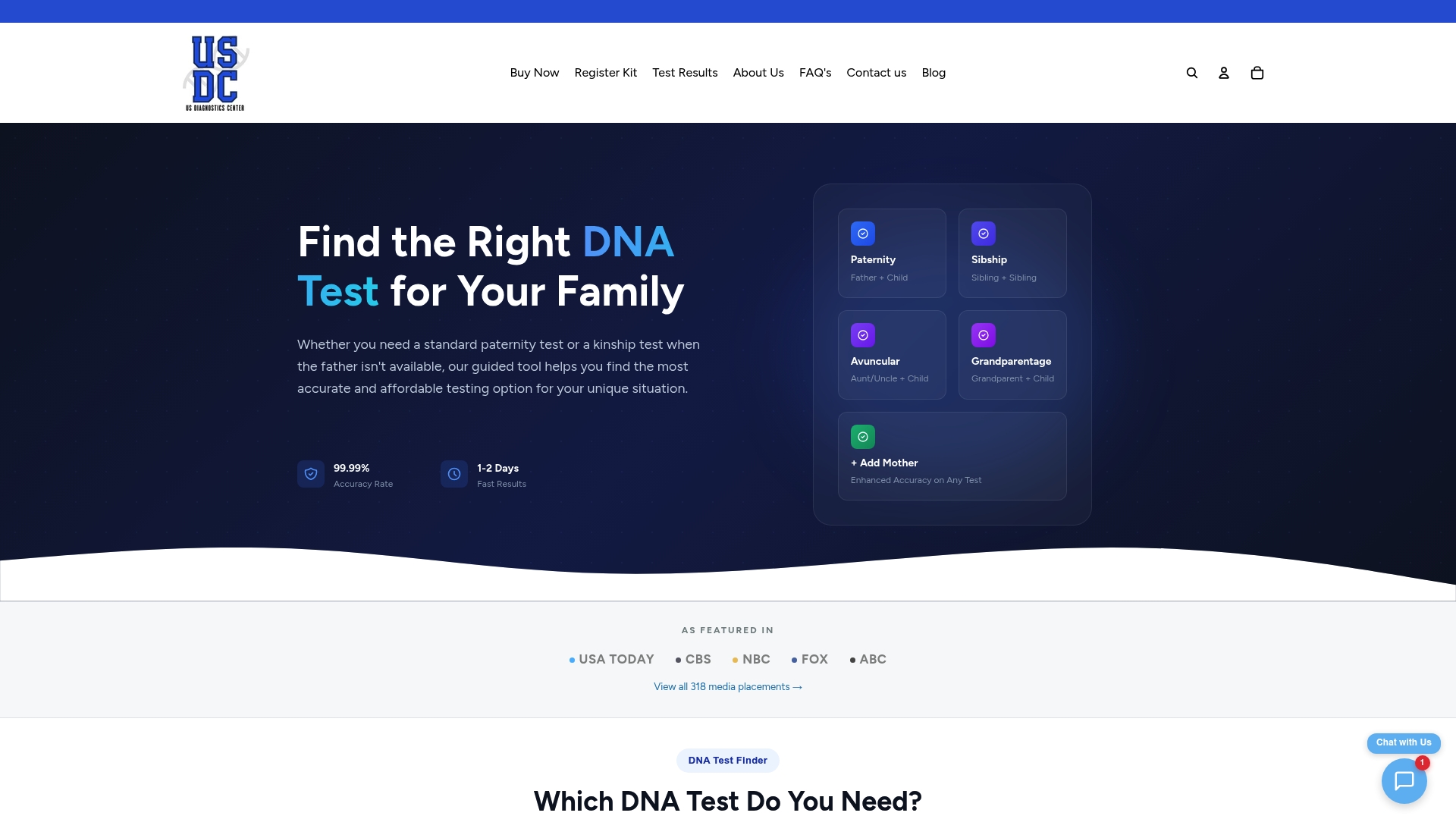
Home kits start at $79 for paternity, $129 for maternity, and $139 for sibling, grandparent, or aunt/uncle testing, with results typically in 7 to 10 business days and expedited processing available when you need answers faster. If your situation involves a legal dispute, a court-admissible chain-of-custody test protects your results from being challenged later. If you just need clarity for yourself and your family, a private at-home kit gets you there without the added paperwork. Start by picking your relationship scenario on the US Diagnostics Center site and let the guided tool recommend the right panel for your case.
Sources
- Twenty Years Later: A Comprehensive Review of the X Chromosome Use in Forensic Genetics
- Genetics reference on sex chromosome inheritance
- Resolving Paternity Relationships Using X‑Chromosome STRs and Bayesian Networks
FAQ
What is X chromosome testing used for?
It's used to resolve kinship questions involving daughters, sisters, grandmothers, or deficiency cases where the alleged father cannot be tested directly.
Does X chromosome testing work for father-son cases?
No. Sons inherit their X chromosome from their mother, so X markers carry no information about a father-son relationship.
How is X chromosome testing different from autosomal testing?
Autosomal testing remains the standard for most paternity cases, while X chromosome analysis is added specifically when the case involves female offspring or a missing alleged father.
What does the likelihood ratio in my results mean?
The likelihood ratio shows how many times more probable your DNA pattern is under the claimed relationship compared to a random match. For kinship tests — sibling, grandparent, avuncular — labs report this as a Combined Relationship Index (CRI): a CRI above 10 supports the claimed relationship, 0.1 to 10 is inconclusive, and below 0.1 is not supportive. For deficiency paternity cases, the likelihood ratio is converted to a probability of parentage.
Can US Diagnostics Center run X chromosome analysis?
Yes, US Diagnostics Center offers kinship panels that can include X-STR markers with up to 28 markers total, with standard results in 7 to 10 business days.
Recommended
- 8 Situations Where a Sibling DNA Test Is the Answer | USDC
- Kinship DNA Testing Examples: A Clear Guide | USDC
- Kinship DNA Tests: Sibling, Grandparent & More | USDC
- Y-STR DNA Testing: Confirming Paternal Line (2026) | USDC
This article is part of our Kinship DNA Testing: Sibling, Grandparent, and Family Relationship Tests and Understanding DNA Testing: How It Works and What to Expect guides.


0 comments